



How Does PVC Pipe Improve Drainage Networks?


Upgrading or constructing drainage networks requires balancing upfront material choices and long-term infrastructure reliability. You need a robust system built to withstand decades of intense physical use. Failing to specify the correct piping often leads to severe root intrusion. It also causes differential settlement leaks and catastrophic flow bottlenecks. These recurring issues disrupt vital municipal operations and force premature, large-scale infrastructure replacements.
While materials like corrugated HDPE, concrete, and cast iron serve specific traditional use cases, rigid PVC pipe has firmly established itself as the baseline standard for modern gravity and pressure drainage. This guide carefully breaks down the essential performance metrics and complex sizing standards you need. You will also learn the specific procurement criteria necessary for objectively evaluating PVC against alternative piping systems.
Key Takeaways
Hydraulic Efficiency: PVC’s ultra-smooth interior surface yields a superior Manning’s roughness coefficient, allowing for flatter grading and higher flow volumes compared to concrete or corrugated alternatives.
Structural Integrity & Lifespan: When properly bedded, rigid PVC resists soil loads, root intrusion, and chemical corrosion, offering a verifiable lifespan exceeding 50+ years.
Specification Matching: Selection must strictly align with ASTM standards (e.g., SDR 35, Schedule 40) based on load-bearing requirements and burial depth.
Strategic Sourcing: Partnering with a vetted supplier ensures access to proper fittings, reliable lead times, and custom fabrication for complex network junctions.
Evaluating Drainage Materials: The Business Case for PVC Pipe
Modern drainage networks must meet strict success criteria to function effectively over time. Civil engineers and project managers prioritize minimal maintenance requirements. They demand maximum flow capacity under heavy demand. They also require zero exfiltration or infiltration to protect surrounding groundwater. You must evaluate every piping material against these rigid operational benchmarks.
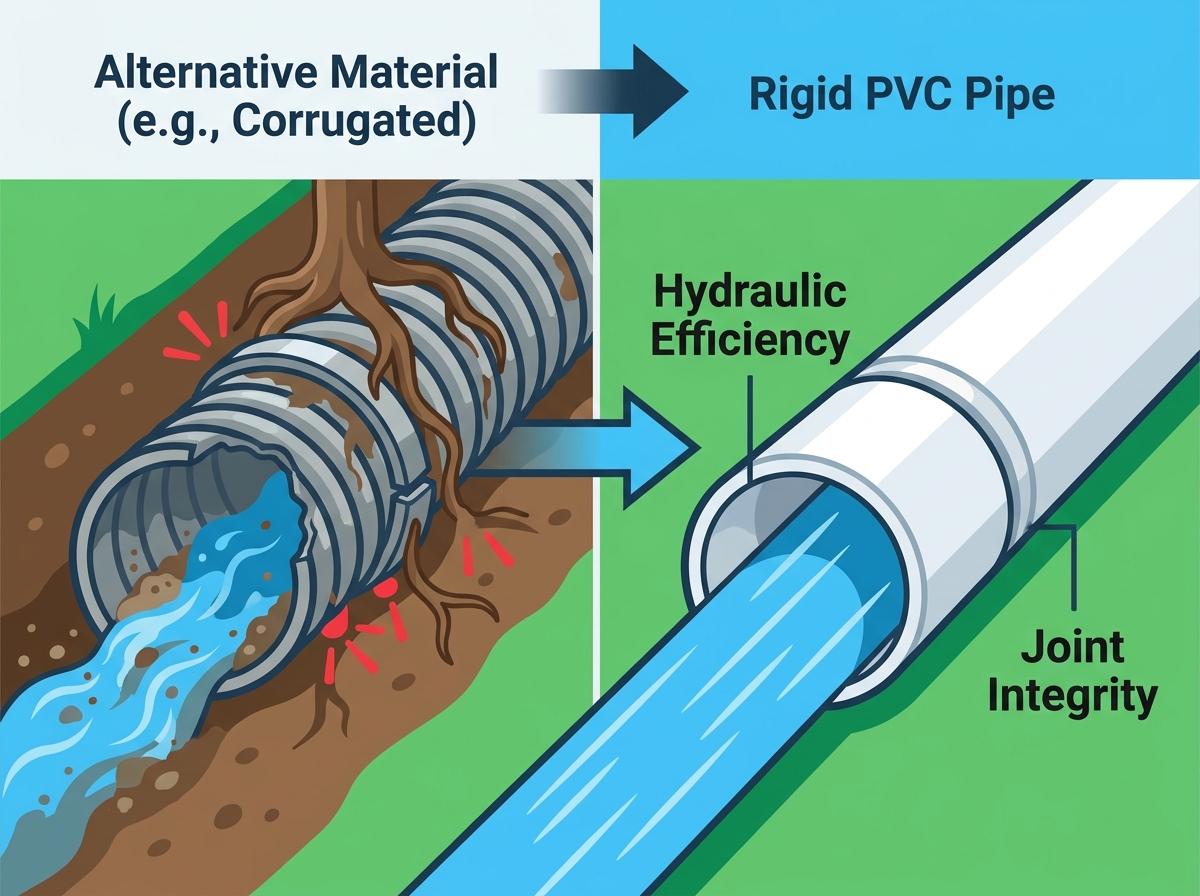
We can establish a clear comparative baseline by looking at alternative materials frequently specified in civil projects. Corrugated Advanced Drainage Systems (ADS) remain popular for specific agricultural or temporary applications. However, PVC provides significantly superior joint integrity. Corrugated pipe often relies on simple snap-fit joints. PVC utilizes highly secure solvent-welded or specialized elastomeric gasket joints. Rigid plastic resists crushing under heavy soil weight much better than flexible corrugated options. You do need to execute more precise trenching and bedding procedures to harness this strength.
Concrete pipes represent the old standard for massive sanitary sewers. Yet, concrete brings massive logistical challenges. Polyvinyl chloride is incredibly lightweight. You completely eliminate the need for massive heavy-lifting cranes on site. Furthermore, concrete remains highly susceptible to hydrogen sulfide (H2S) corrosion. This biogenic sulfide corrosion rapidly degrades concrete sanitary sewers from the crown down. Rigid plastic remains completely immune to this common biological attack.
We must maintain a transparent assumption regarding application environments. This material is absolutely optimal for buried gravity drainage. You cannot simply leave standard pipe exposed to direct sunlight indefinitely. Above-ground installations continuously exposed to weather require specific UV-resistant formulations. Alternatively, you must apply physical shielding to prevent long-term ultraviolet degradation.
Material Comparison for Modern Drainage Systems
Material Type | Joint Integrity | Corrosion Resistance | Installation Weight | Ideal Application |
|---|---|---|---|---|
Rigid PVC | Excellent (Gasket/Solvent) | High (Immune to H2S) | Lightweight | Buried Sanitary & Storm Sewers |
Corrugated ADS | Moderate (Snap-fit) | High | Ultra-Lightweight | Agricultural & French Drains |
Concrete | Good (Heavy Gaskets) | Poor (Vulnerable to H2S) | Extremely Heavy | Massive Highway Culverts |
Engineering Advantages of Drainage Networks PVC Pipe
Engineers consistently choose this material based on provable fluid dynamics. Friction loss dictates how efficiently water moves through a gravity system. Ultra-smooth internal walls actively prevent heavy sludge buildup. They also resist mineral scale accumulation over decades of continuous use. We measure this efficiency using Manning’s "n" value. Polyvinyl chloride boasts an incredibly low "n" value of approximately 0.009. Standard concrete pipes typically measure around 0.013. This mathematical advantage means you can design networks using much flatter grading. Flatter slopes significantly reduce deep excavation requirements and save massive amounts of project time.
Chemical and biological resistance represents another major engineering advantage. The fundamental molecular structure remains chemically inert. It simply does not react aggressively to volatile soil conditions. Acidic rainwater runoff will not etch the interior walls. Highly caustic industrial effluent passes through the system without degrading the structural integrity. You do not have to worry about the surrounding soil pH levels compromising your buried infrastructure.
Joint integrity serves as the ultimate defense mechanism for any underground network. Drainage systems almost universally fail at the connection points. You can utilize solvent-cemented joints for smaller residential applications. You will typically specify elastomeric gasket joints for larger municipal mains. Both methods effectively eliminate the primary failure mechanisms.
Root Intrusion Prevention: Tree roots seek moisture aggressively. Tight gaskets deny roots any entry point into the system.
Exfiltration Control: Raw sewage cannot leak out into the surrounding soil. This protects the local water table from hazardous contamination.
Infiltration Reduction: High groundwater cannot seep into the sanitary sewer. This prevents municipal treatment plants from becoming hydraulically overloaded during heavy rain events.
You can confidently deploy drainage networks PVC pipe knowing these connections will remain watertight for generations.
Decoding PVC Pipe Specifications for Project Compliance
Selecting the correct product requires a deep understanding of industry sizing methodologies. You must understand the crucial difference between Schedule sizing and Standard Dimension Ratio (SDR) sizing. Schedule 40 and Schedule 80 refer to specific wall thicknesses assigned to distinct pipe diameters. Schedule 40 works exceptionally well for pressurized residential plumbing. However, municipal gravity sewer networks rely almost exclusively on SDR sizing.
Standard Dimension Ratio describes a specific mathematical relationship. It represents the ratio of the pipe's outside diameter to its wall thickness. SDR 35 serves as the universally recognized baseline industry standard for gravity sewer networks. Because the ratio remains perfectly constant across all sizes, an 8-inch SDR 35 pipe shares the exact same physical pressure rating and deflection characteristics as a 15-inch SDR 35 pipe. This consistency allows engineers to accurately predict network behavior regardless of volume requirements.
You must rigorously validate all PVC pipe specifications against established regulatory standards. Reputable engineering firms demand strict adherence to the American Society for Testing and Materials (ASTM) codes. You should look for the ASTM D3034 certification when specifying solid wall gravity sewer systems. You should verify the ASTM D1785 certification when utilizing Schedule 40 or Schedule 80 variants. These stamps of approval guarantee the material meets stringent impact resistance and dimensional tolerance tests.
Sizing the pipe correctly dictates the overall success of the application. You must match the exact diameter to the specific use case.
Residential Yard Drainage: Small-scale downspout routing and french drains typically require 3-inch to 4-inch Schedule 40 piping.
Commercial Site Runoff: Parking lot catch basins usually connect via 6-inch to 8-inch SDR 35 lines.
Municipal Sanitary Mains: City sewer infrastructure generally demands large 8-inch to 15-inch SDR 35 or SDR 26 piping to handle peak community flow.
Implementation Realities and Installation Risk Mitigation
Even the highest quality materials will fail spectacularly if installed incorrectly. Poor installation practices cause the vast majority of underground infrastructure failures. Proper trenching and bedding requirements are absolutely non-negotiable. Rigid plastic behaves as a flexible conduit under heavy soil loads. It relies entirely on the surrounding soil envelope for structural support. You must provide proper aggregate bedding to support the pipe's lower haunches. Compacting crushed stone securely under the curved sides prevents excessive vertical deflection. If you skip this critical step, heavy backfill will crush the line over time.
Best Practices for Trenching: Always excavate a trench wide enough to safely operate compaction equipment alongside the pipe. Ensure the trench bottom remains entirely free of large, jagged boulders.
Common Mistakes: Do not dump native clay backfill directly on top of exposed plastic pipe. Clay provides zero structural haunch support and shifts unpredictably during freeze-thaw cycles.
Temperature fluctuations create another significant installation risk. Plastic materials experience substantial thermal expansion and contraction. The pipe literally grows and shrinks depending on ambient weather conditions. You must make specific mathematical allowances for this movement during installation. This becomes particularly vital in long, straight runs exposed to direct sun before burial. Snaking the pipe slightly in the trench helps accommodate this inevitable physical shift.
Cold weather creates unique physical vulnerabilities. Extreme freezing temperatures significantly reduce the material's baseline impact resistance. The pipe becomes brittle and prone to shattering if dropped abruptly. You must implement strict evidence-based site handling procedures during winter months. Crews should never throw joints off flatbed delivery trucks. Gentle offloading prevents microscopic hairline fractures. These invisible micro-fractures frequently expand into massive catastrophic leaks once the system undergoes hydrostatic testing.
Shortlisting Your PVC Pipe Supplier
Procuring materials requires far more strategy than simply hunting for the lowest price per foot. You must evaluate potential vendors across several critical dimensions. Inventory depth stands out as a primary deciding factor. A vendor must consistently stock the exact fittings matching your specified pipe. Delays caused by mismatched gaskets or missing wyes will instantly destroy your construction schedule. You should also scrutinize their delivery logistics capabilities. Ask how they physically transport materials to remote job sites to prevent transit damage.
Furthermore, QA/QC documentation remains completely vital. Reputable vendors cheerfully provide detailed testing records verifying their products meet every stated ASTM requirement. Do not accept vague verbal assurances regarding material quality.
Complex network layouts frequently defy standard sizing parameters. Standard 45-degree or 90-degree angles will not always fit tightly congested underground utility corridors. You must evaluate a vendor's unique ability to handle complex custom PVC pipe requirements. Complex jobs might demand specialized mechanical perforations for unique infiltration fields. Sometimes you need highly specific factory-cut lengths to navigate around existing municipal concrete vaults. Ensure your chosen partner possesses the in-house fabrication capabilities required to solve these unexpected engineering puzzles.
Your immediate next-step action involves rigorous verification. You should always request comprehensive submittal data from any shortlisted PVC pipe supplier. Demand current material safety data sheets (MSDS) for all supplied solvent cements and primers. Finally, require physical product samples before finalizing any massive procurement contracts. Inspecting the actual wall thickness and gasket quality provides immense peace of mind before breaking ground.
Conclusion
Polyvinyl chloride consistently delivers exceptional operational value for modern drainage networks. The system achieves unparalleled hydraulic efficiency due to its friction-resistant interior walls. You can expect remarkable longevity because the material utterly resists aggressive biological corrosion and intrusive tree roots. When crews follow predictable installation parameters, these underground networks routinely outlast their initial design life projections.
Engineers and contractors must collaborate closely to ensure project success. We encourage project managers to rigorously review their exact site soil conditions and anticipated surface load requirements. Do not leave crucial sizing decisions to guesswork.
Verify all chosen materials strictly match necessary ASTM D3034 or D1785 standards.
Ensure your installation crews utilize proper crushed aggregate for trench haunch support.
Account for thermal expansion during prolonged exposed site conditions.
Contact a dedicated technical sales representative to confirm your exact application specifications.
FAQ
Q: Is PVC or corrugated pipe better for underground drainage?
A: PVC is superior for longevity, crush resistance, and joint integrity (preventing roots and clogs). Corrugated pipe is often cheaper and more flexible but is prone to crushing, sediment buildup, and root intrusion if not installed perfectly.
Q: What is the minimum PVC pipe size recommended for commercial drainage networks?
A: While site-specific, commercial gravity mains typically start at 6-inch to 8-inch SDR 35 PVC, ensuring adequate capacity for peak flow and minimizing blockage risks.
Q: How deep does PVC drainage pipe need to be buried?
A: Burial depth depends on the pipe's SDR/Schedule rating, soil type, and surface loads (e.g., vehicular traffic). Generally, a minimum of 12 to 24 inches of proper cover is required to distribute live loads safely, though frost lines must also be considered.