



What Specs Matter When Buying CPVC Fitting?


Procuring the wrong fittings hides massive financial and safety risks. You might face premature system failure, heavy compliance fines, or catastrophic leaks in pressurized lines. Poor component choices disrupt entire facilities and threaten personnel safety. Chlorinated Polyvinyl Chloride (CPVC) stands as the industry standard for high-temperature and corrosive environments. However, manufacturers do not create all CPVC equally. Raw material quality, dimensional consistency, and production tolerances vary wildly across brands. You need precise technical data to make informed choices. This article provides a technical, vendor-neutral framework. It will help you rigorously evaluate a CPVC pipe fitting before committing to a purchase order. You will learn exactly which parameters ensure safety, compliance, and long-term durability across complex industrial installations.
Key Takeaways
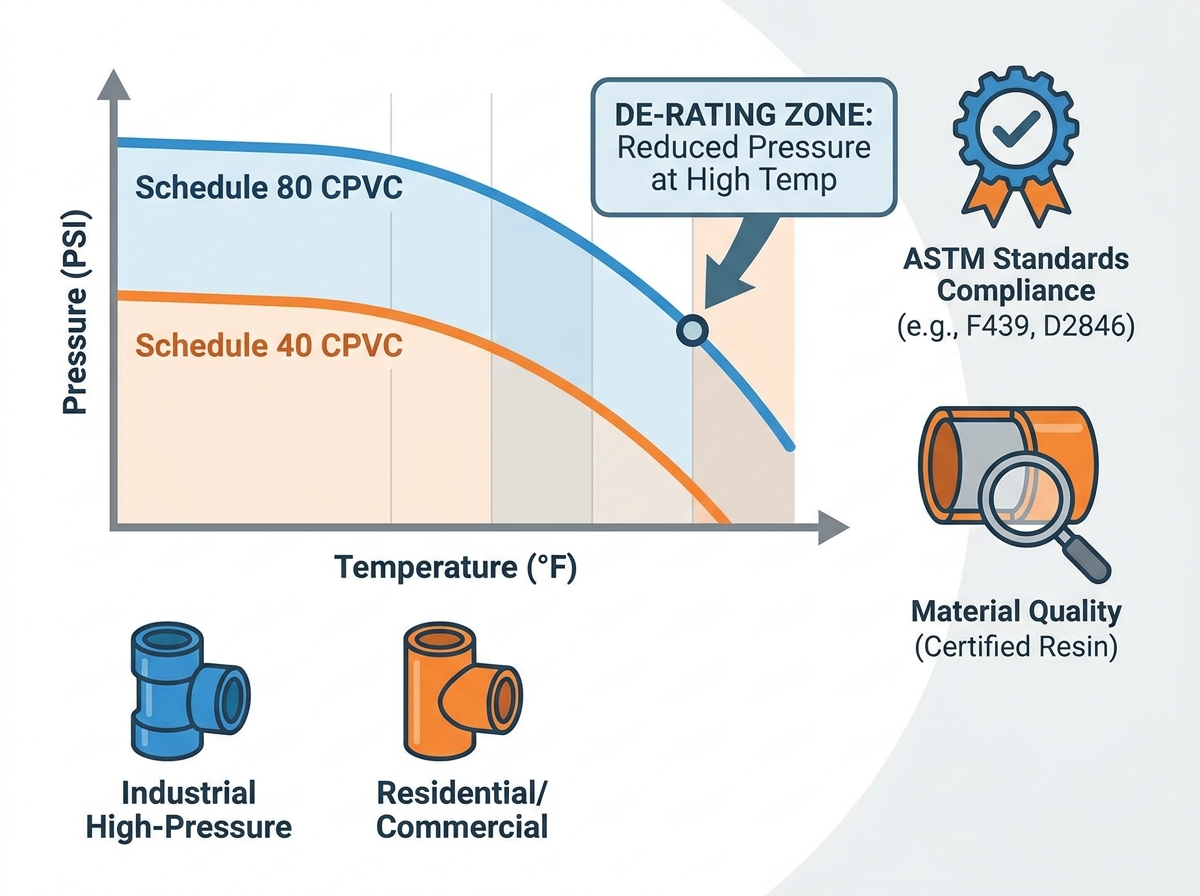
Pressure ratings for CPVC drop as temperature increases; specifications must account for maximum operational baselines, not just ambient conditions.
ASTM standards (e.g., ASTM F439, D2846) and proper Cell Classification are non-negotiable for commercial and industrial compliance.
Selecting between Schedule 40 and Schedule 80 depends entirely on the fluid’s pressure dynamics and mechanical stress on the system.
Evaluating a CPVC pipe fitting supplier requires vetting their material sourcing, batch testing protocols, and custom fabrication capabilities.
Critical CPVC Pipe Fitting Specifications for System Integrity
Cell Classification Fundamentals
Engineers rely on the ASTM D1784 cell classification system to determine material quality. You will often see a classification number like 23447 on technical data sheets. This sequence directly dictates the base resin properties. Each digit represents a specific mechanical threshold. The first number identifies the material itself. The subsequent digits measure impact resistance, tensile strength, modulus of elasticity, and heat deflection temperature.
Higher numbers indicate stronger material properties. If you specify a lower classification for an aggressive industrial application, the material will likely fail under stress. Understanding these numbers ensures you select a resin capable of handling your specific fluid dynamics. Always verify the cell class before approving any material submittals.
Temperature and Pressure De-rating
Plastics lose structural strength as they heat up. We must face a strict engineering reality. A component rated for 400 PSI at 73°F will absolutely not hold that pressure at 180°F. Elevated temperatures soften the polymer matrix. You must apply a mathematical de-rating factor to determine the true operational limit.
For example, if the derating factor at 180°F is 0.25, your 400 PSI rating drops to a mere 100 PSI. You must highlight these specific spec requirements when evaluating a hot water systems CPVC pipe fitting. Ignoring derating curves guarantees eventual blowouts. Always design around the maximum operational temperature, never the ambient room temperature.
Schedule 40 vs. Schedule 80 Parameters
Wall thickness separates Schedule 40 from Schedule 80. Both schedules share the same outside diameter to ensure compatibility across standard support hangers. However, Schedule 80 features much thicker walls. This extra thickness shrinks the interior flow area. Consequently, Schedule 80 restricts flow rates and increases fluid velocity compared to Schedule 40.
Follow a simple shortlisting rule for your projects. Use Schedule 80 for chemical processing and industrial high-pressure environments. The extra material withstands aggressive corrosion and physical impacts. Conversely, select Schedule 40 for low-pressure residential or commercial water distribution. It offers better flow characteristics and lowers material costs.
Parameter | Schedule 40 | Schedule 80 | Primary Application |
|---|---|---|---|
Wall Thickness | Standard | Heavy / Thick | - |
Pressure Rating | Moderate | High | - |
Internal Flow Area | Maximum | Reduced | - |
Best Use Case | Commercial Water Distribution | Chemical Transport & Industrial | Determines Selection |
Navigating Industry Standards and Compliance
ASTM Certifications
Baseline standards protect your facility from catastrophic failures. You must demand strict adherence to ASTM certifications. ASTM F439 governs socket-type Schedule 80 components. It dictates rigorous dimensional tolerances and burst testing requirements. Meanwhile, ASTM D2846 covers hot and cold water distribution systems. Procuring components lacking these stamps invites legal liability. Verifying proper CPVC pipe fitting specifications guarantees compliance during municipal building inspections.
Potable Water & Health Codes
Drinking water applications require specialized safety certifications. NSF/ANSI 14 evaluates the physical performance of plastic piping system components. It ensures the structural integrity remains intact over decades. NSF/ANSI 61 focuses entirely on health effects. It rigorously tests materials to ensure no dangerous chemicals leach into the drinking water supply. You must verify both certifications before installing any components in a potable water network. Missing these marks violates local health codes instantly.
Fire & Smoke Ratings
Commercial building construction places heavy scrutiny on materials located inside plenum spaces. Plenums handle air circulation for HVAC systems. If a fire breaks out, burning plastics can spread toxic smoke rapidly through the ductwork. ASTM E84 compliance evaluates flame spread and smoke development indices. Materials installed in return air plenums must meet a 25/50 rating. This means a flame spread index under 25 and a smoke developed index under 50. Always demand E84 test reports for commercial high-rise projects.
Assessing Joint and Connection Types
Solvent Weld Sockets
Solvent welding fuses plastics together at a molecular level. Variables in socket depth specifications directly impact joint strength. Deeper sockets provide more surface area for the chemical bond. Dimensional consistency matters immensely here. If the socket diameter runs too large, you risk creating a dry fit. The solvent cement cannot bridge excessive gaps. High-quality manufacturing ensures a slight interference fit. You should feel resistance when pushing the pipe into the socket before applying cement. This tight tolerance prevents leaks and ensures structural permanence.
Bevel the pipe edge before insertion to prevent scraping the cement off the socket walls.
Always apply an approved CPVC primer to soften the material before adding cement.
Hold the joint together for at least 30 seconds to prevent push-out.
Threaded Connections
Threading plastics introduces inherent mechanical weaknesses. Cutting threads removes material and creates stress risers. Why do male versus female threads matter? Female plastic threads expand when subjected to internal pressure. This expansion often causes the fitting to crack straight down the side. Male plastic threads compress inward, making them slightly more resilient.
We strongly recommend avoiding female threaded plastic components altogether. Instead, utilize metal-to-plastic transition unions. These specialized parts feature brass or stainless steel threads molded into a CPVC socket. They handle mechanical torque safely and eliminate the risk of stress cracking.
Flanged Fittings
Industrial systems frequently rely on flanged connections to integrate pumps or heavy valves. Evaluation criteria must include bolt-hole alignment and flange thickness. Poorly molded flanges warp under pressure. You must follow strict torque limits to prevent stress-cracking during installation. Over-tightening the bolts will snap the plastic flange immediately. Use a calibrated torque wrench and follow a traditional star-pattern sequence. This method distributes the compressive load evenly across the entire flange face, preserving the material integrity.
When Standard Specs Fail: The Role of a Custom CPVC Pipe Fitting
Identifying the Need for Customization
Standard catalogs cover the vast majority of commercial applications. However, complex industrial environments often present unique geometry challenges. You might encounter non-standard angles routing around immovable machinery. Legacy plumbing retrofits frequently demand transition pieces unavailable on modern shelves. Proprietary industrial equipment often features non-standard port dimensions. In these specific scenarios, procuring a precisely engineered custom CPVC pipe fitting becomes absolutely necessary to bridge the gap safely.
Tolerances and Prototyping
Reviewing custom spec sheets requires close attention to detail. You must check the machining tolerances. CNC-machined parts offer incredible precision but lack the continuous fiber strength of injection-molded pieces. Understand the structural differences between molded and fabricated strengths. Fabricated components often rely on hot-air welding techniques. These welds handle less pressure than seamless molded designs. Request prototype testing data to confirm the custom part meets your maximum pressure requirements safely.
Cost vs. Lead Time ROI
Custom manufacturing demands a strategic evaluation of upfront costs versus installation time. Is it better to adapt standard components using elaborate workarounds? Workarounds consume valuable labor hours and introduce unnecessary weak points into the system. Investing in custom manufacturing carries higher initial tooling costs. However, a single custom part installs in minutes. This dramatically reduces onsite labor costs. Evaluate the return on investment by comparing the fabrication lead time against the projected labor savings and system reliability improvements.
How to Evaluate a CPVC Pipe Fitting Supplier
Material Sourcing Transparency
The final product quality depends entirely on the raw ingredients. Differentiate between vendors using domestic, certified raw CPVC resin versus unbranded alternatives. Premium resins like Corzan or FlowGuard offer predictable, thoroughly tested chemical resistance. Unbranded resins often contain high volumes of calcium carbonate fillers. Manufacturers use these fillers to reduce production costs. Unfortunately, heavily filled resins become brittle and lose their chemical resistance rapidly. Demand full transparency regarding raw material origins before signing a contract.
Quality Assurance & Batch Testing
A vendor must prove their reliability through documentation. Set firm expectations for quality assurance records. You need access to burst testing results. Demand dimensional tolerance checks showing minimal deviation from ASTM standards. Request hydrostatic pressure reports detailing long-term performance under stress. A top-tier CPVC pipe fitting supplier provides these documents proactively. If a vendor hesitates to share batch testing data, eliminate them from your procurement list immediately.
Evaluation Category | Critical Metrics to Check | Red Flags to Avoid |
|---|---|---|
Material Quality | Certified resin brands, correct cell classification. | High filler content, unknown origins. |
Documentation | Hydrostatic reports, dimensional QA sheets. | Refusal to provide batch testing data. |
Compliance | ASTM F439, NSF 14/61 certifications. | Missing third-party testing stamps. |
Fulfillment | Scalable inventory, fast emergency dispatch. | Consistent backorders on common sizes. |
Inventory Scalability and Logistics
Large-scale projects experience frequent schedule changes. You must assess the vendor's ability to handle erratic logistics. Can they manage complex split shipments directly to different job sites? Evaluate their capacity for massive bulk procurement. Determine how they handle emergency site deliveries when unexpected pipe breaks occur. Crucially, verify their quality control processes remain strict during high-volume rush orders. Speed must never compromise dimensional accuracy.
Conclusion
Maximum operating temperatures and aggressive fluid dynamics must drive your purchasing decisions. You cannot compromise on material quality when dealing with corrosive chemicals or pressurized hot water. Strict adherence to ASTM standards guarantees baseline safety. Verified vendor reliability ensures your facility stays online without unexpected blowouts. Trusting cheap, unverified components ultimately leads to catastrophic mechanical failures.
Take the following action-oriented steps to secure your next procurement cycle:
Gather accurate flow, temperature, and pressure data for your current system.
Audit existing plumbing lines to identify failing or incorrectly specified fittings.
Request technical data sheets (TDS) and cell classification records from all shortlisted vendors.
Verify third-party certifications like NSF/ANSI and ASTM via independent databases.
FAQ
Q: Does CPVC become brittle over time, and how do specifications prevent this?
A: Yes, prolonged UV exposure and chemical degradation can cause brittleness over decades. However, proper specifications mitigate this risk entirely. Using the correct cell classification ensures high baseline impact resistance. Outdoor installations require specific UV-resistant coatings or protective jacketing. Specifying high-grade, certified resins prevents premature degradation and significantly extends the functional lifespan of your industrial plumbing network.
Q: What is the maximum temperature a standard hot water systems CPVC pipe fitting can handle?
A: The absolute hard limit typically sits at 200°F (93°C). However, you cannot operate at maximum pressure at this extreme temperature. Engineers must apply a pressure derating factor. A system operating near 200°F handles only a small fraction of its ambient pressure rating. You must consult manufacturer derating curves before finalizing any system designs.
Q: Can I mix CPVC fittings from different manufacturers?
A: You should avoid mixing brands whenever possible. Dimensional variations exist even within allowable ASTM tolerances. This causes loose fits, dry joints, or solvent cement incompatibility. Sticking to a single, reliable supplier ensures seamless joints. Consistent sourcing prevents mechanical weak points and maintains uniform structural integrity across your entire facility.
Q: Do CPVC pipe fitting specifications differ for chemical transport versus water?
A: Yes, they differ significantly. Chemical transport requires strict adherence to detailed chemical compatibility charts. Aggressive fluids break down standard plastics rapidly. Engineers universally mandate Schedule 80 for chemical lines. The much thicker walls withstand higher pressures and provide essential extra material depth against internal chemical corrosion over time.