



Which PVC Fitting Design Fits Water Supply?


Selecting the correct component for water supply systems is not just a matter of matching diameters. It is a critical compliance and engineering decision. Improper fitting selection leads to friction loss and structural failure under hydrostatic pressure. It also causes severe building code violations, especially regarding potable water safety. You must avoid these risks to ensure continuous, safe operation across any installation environment. This guide outlines the exact evaluation criteria, ranging from material properties to complex connection designs. It will help you choose the most reliable water supply PVC pipe fitting for your specific commercial or residential plumbing application. You will learn how to navigate NSF standards, evaluate burst pressure ratings, and match internal geometries to system demands perfectly.
Key Takeaways
Standard PVC is restricted to cold water applications; hot water distribution requires CPVC or alternative materials to meet building codes.
Evaluating PVC pipe fitting specifications—specifically Schedule 40 versus Schedule 80—is mandatory to align wall thickness with system pressure requirements.
Solvent-welded joints offer superior long-term reliability for concealed water supply lines compared to threaded connections, which are prone to over-tightening stress.
Partnering with a compliant PVC pipe fitting supplier ensures access to NSF-certified components and custom configurations for complex layouts.
Potable Water Compliance: The NSF/ANSI Standards Framework
You must address the primary business problem first. Ensuring the fitting material does not leach toxins into drinking water systems remains your top compliance focus. You cannot simply use any plastic component for human consumption lines. Uncertified plastics release volatile organic compounds into the water stream over time.
Standard PVC vs. CPVC
You need to define the strict temperature limitations before planning your system. Standard PVC is strictly for cold water distribution. It handles temperatures up to 140°F maximum. However, practical operational limits usually sit much lower, around 73°F, before pressure derating becomes necessary. CPVC handles hot water applications safely up to 200°F. You will compromise system integrity rapidly if you push standard plastics beyond their thermal ceilings.
NSF/ANSI 61 Certification
You must verify the certification stamps on every component. Look closely at the exterior of the fitting. Ensure it carries the "NSF-PW" (Potable Water) or "NSF-61" stamp. This physical mark confirms the manufacturer submitted the product for independent laboratory testing. It proves the component is legally approved for potable water distribution. Inspectors will reject uncertified parts immediately.
Building Code Realities
Many local jurisdictions actively limit indoor water distribution materials. They often restrict indoor supply lines to CPVC or PEX. This relegates standard PVC primarily to main water service lines running outside the building envelope. You will also see it used heavily in irrigation systems. Always consult municipal plumbing codes before finalizing your material schedules.
Best Practices for Compliance
Check local municipal codes for specific material exclusions before purchasing.
Keep material safety data sheets accessible on the job site.
Do not mix uncertified industrial components into potable residential lines.
Schedule 40 vs. Schedule 80: Matching PVC Pipe Fitting Specifications to Pressure
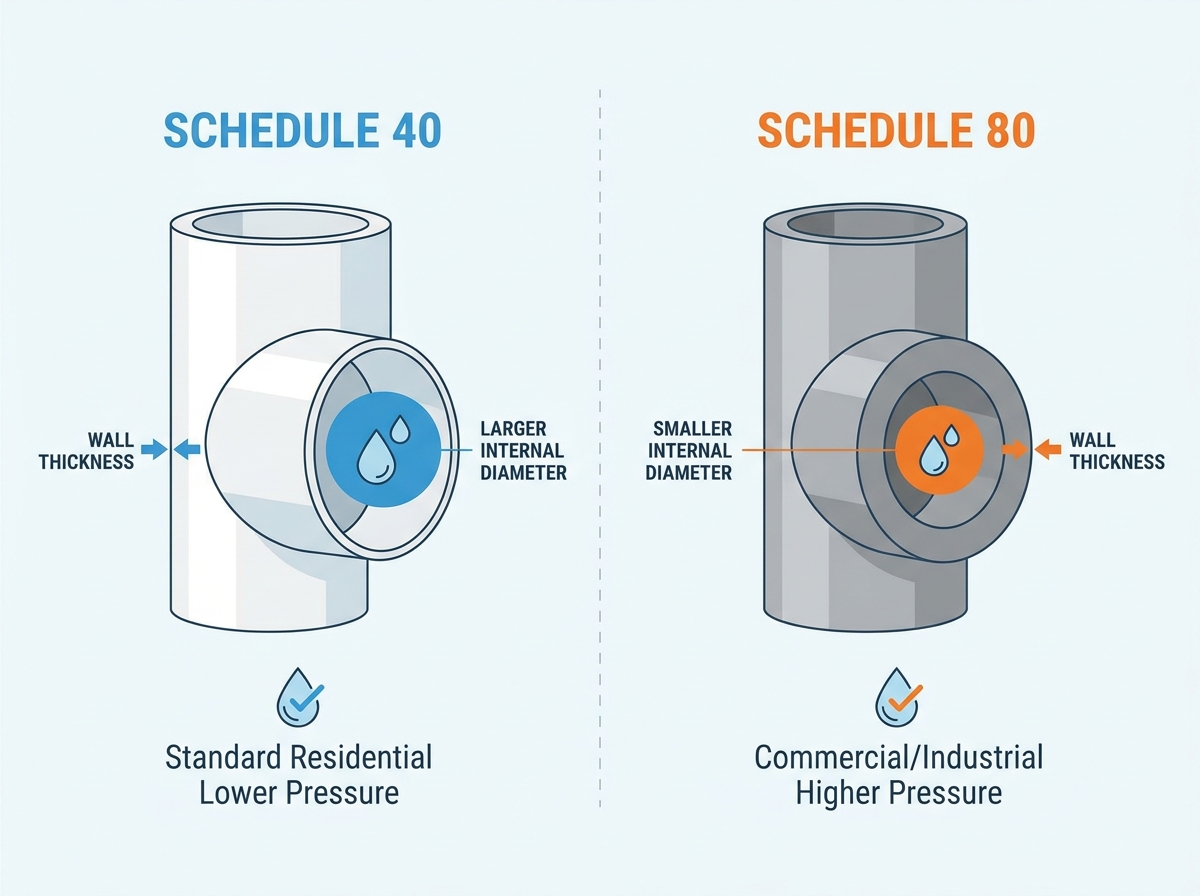
Your primary evaluation criteria must center on wall thickness and hydrostatic burst pressure. Wall thickness dictates how much internal stress the component survives. You must analyze the PVC pipe fitting specifications carefully to match system demands. Mixing up schedules leads to catastrophic blowouts or inefficient flow rates.
Schedule 40 (White)
You will recognize Schedule 40 components by their standard white color. They represent the industry baseline for many common plumbing tasks.
Ideal Use Case: You should use these for standard residential water service lines. They work perfectly for irrigation and low-pressure cold water distribution networks.
Limitations: Thinner walls reduce safety margins significantly. They offer less protection against water hammer pressure spikes. They also fail faster upon physical impact. You should avoid placing them in high-traffic industrial areas where forklifts or heavy machinery operate.
Schedule 80 (Gray)
Schedule 80 components feature a distinctive gray color. Manufacturers design them specifically for heavy-duty environments demanding superior structural resilience.
Ideal Use Case: These serve commercial water supply lines exceptionally well. You will find them in industrial chemical processing and exposed exterior lines. They withstand harsh operational realities daily.
Implementation Reality: Schedule 80 fittings handle higher PSI seamlessly. However, they possess a smaller internal diameter than Schedule 40 equivalents. You must factor this geometry change into your system friction loss and flow rate (GPM) calculations. A restricted internal diameter accelerates fluid velocity and increases pump strain.
Specification Feature | Schedule 40 | Schedule 80 |
|---|---|---|
Color Indicator | White | Gray |
Wall Thickness | Standard | Thick |
Max Pressure Rating | Lower | Higher |
Internal Diameter | Larger | Smaller |
Primary Application | Residential / Irrigation | Commercial / Industrial |
Common Mistakes in Pressure Matching
Engineers often fail to derate pressure capacities for elevated temperatures. Remember, advertised burst pressures apply at 73°F. Once ambient or fluid temperatures rise, the plastic softens. Its safe operating pressure drops drastically. You must calculate this thermal derating factor prior to installation.
Core Fitting Designs for Water Supply Architecture
Breaking down specific component shapes helps optimize system efficiency. Fluid dynamics dictate how water travels through complex pipeline networks. Every turn creates turbulence. Every junction reduces overall system pressure. You must choose shapes strategically to minimize these losses.
Directional Fittings (Elbows & Sweeps)
Hard 90-Degree Elbows: These force water to make a sudden, sharp turn. They create massive friction loss and induce turbulence. You should use them only in tight wall cavities where space remains strictly limited.
Sweep Elbows: These provide a gradual, curving directional change. They offer vastly superior flow dynamics. You must specify sweep elbows for high-volume supply lines. They keep fluid velocity stable and reduce pump workload effectively.
Branching Fittings (Tees vs. Wyes)
Standard Tees: A tee splits fluid flow at a harsh 90-degree angle. You should use standard tees primarily for low-velocity secondary lines. They work fine for basic residential branch feeds.
Wye Fittings: Wyes split the flow at a gentle 45-degree angle. Explain this clearly to your installation team. You must use wyes to reduce turbulence in main supply feeds. They maintain directional momentum and prevent cavitation inside the pipe.
Maintenance & Transition Fittings (Unions & Adapters)
Unions: You must highlight the necessity of unions near pumps, meters, and isolation valves. A union allows technicians to disconnect the line for future serviceability without cutting the pipe. It saves hours of labor during routine maintenance.
Adapters: These components allow you to transition from plastic to metal safely. They feature threads on one side and a slip hub on the other. Always install adapters carefully to prevent dissimilar material expansion issues.
Connection Methodology: Solvent Welding vs. Threading Risks
How you join the PVC pipe fitting directly dictates the failure rate of the water supply line. A poorly executed joint will leak, regardless of component quality. You have two primary methodologies, each carrying specific implementation realities.
Solvent Welding (Slip Fittings)
Solvent welding relies on a chemical reaction rather than physical adhesion. The primer softens the plastic. The cement then melts the two surfaces together.
Pros: It creates a permanent, molecularly bonded joint. A properly welded slip joint withstands the pipe's full rated pressure without flinching. It essentially forms one continuous piece of plastic.
Risks: You must adhere strictly to primer and cement curing times. Rushing the pressurization phase causes blowouts. This method remains highly unforgiving of alignment errors. Once the cement sets, you cannot adjust the angle. You must cut the pipe and start over.
Threaded Connections
Threaded plastic joints provide modularity. Installers use them primarily for equipment transitions.
Pros: Threading allows for rapid disassembly. It makes transitions to metal plumbing components straightforward. You can swap out a defective valve in minutes.
Risks: You face a high risk of stress cracking if you over-tighten the joint. Plastic threads deform easily under torque. You must detail the necessity of using thread seal tape (Teflon) exclusively. Avoid using liquid pipe dope on plastic threads. Many chemical pastes degrade plastic molecularly, causing sudden brittle fractures weeks after installation.
Best Practices for Connections
Always use a deburring tool to remove rough edges before applying primer.
Hold the welded joint together firmly for at least 30 seconds to prevent push-out.
Hand-tighten threaded joints first, then apply only one extra turn with a strap wrench.
How to Evaluate a Commercial PVC Pipe Fitting Supplier
You need strict criteria for vetting procurement partners for mid-to-large scale plumbing projects. Sourcing unreliable components jeopardizes the entire infrastructure. You must look beyond standard catalogs.
Quality Assurance and Documentation
Look for suppliers who provide transparent technical data sheets. They should openly share their batch testing records. Strict adherence to ASTM standards proves manufacturing consistency. Verify they meet ASTM D2466 for Schedule 40 components. Ensure they meet ASTM D2467 for Schedule 80 parts. A reputable supplier will present these certifications without hesitation.
Customization Capabilities
Standard catalog sizes may not suffice in industrial or highly specific municipal water systems. Sometimes you face spatial constraints or unique flow requirements. Assess the manufacturer's ability to produce a custom PVC pipe fitting. They should tailor it perfectly to your proprietary system dimensions. They must also accommodate specialized stress requirements, such as enhanced UV resistance or modified wall thickness.
Next-Step Action for Procurement
Do not sign large contracts based on digital brochures alone. We recommend requesting material specification sheets and physical sample components first. You need these for physical tolerance testing. Have your engineering team verify the slip hub tolerances and thread depths locally. Once validated, contact your chosen PVC pipe fitting supplier to finalize the bulk procurement contract confidently.
Conclusion
Selecting a reliable fitting for water supply requires balancing strict code compliance, pressure ratings, and flow dynamics. You must identify the correct NSF certifications to protect potable water integrity. You must choose between Schedule 40 and Schedule 80 to match system durability needs accurately. You also need to select the right shape, like sweep elbows or wyes, to reduce internal turbulence.
Base your decision strictly on the system's maximum operating temperature, peak PSI, and local plumbing codes. Ignoring these engineering parameters leads to structural failures. Ensure you follow precise solvent welding procedures to prevent joint leaks.
Take action today to secure your infrastructure. Consult with a certified mechanical engineer to finalize your sizing calculations safely. Alternatively, contact a vetted supplier immediately to request detailed structural specification sheets for your upcoming project.
FAQ
Q: Is standard PVC safe for drinking water?
A: Yes, standard PVC is perfectly safe and widely used for cold drinking water lines, provided the fittings and pipe are explicitly stamped with NSF-61 or NSF-PW certification. This mark guarantees independent laboratory testing confirmed the plastic will not leach harmful chemicals into your potable water supply.
Q: Can I use PVC fittings for hot water supply?
A: No. Standard PVC degrades and loses structural integrity at high temperatures. Hot water distribution requires CPVC, PEX, or copper. Pushing standard plastic past its thermal limit of 140°F causes rapid deformation, pressure derating, and inevitable pipe blowouts.
Q: Should I mix Schedule 40 pipe with Schedule 80 fittings?
A: While they share the same outside diameter and can physically connect, it is best practice to match the schedule of the pipe and fitting to ensure uniform pressure ratings and flow characteristics across the supply system. Mixing them introduces uneven pressure thresholds and alters internal fluid velocity dynamics.