



How to Size CPVC Pipe for Building Plumbing?


Incorrect plumbing sizing doesn't just cause poor water pressure. It leads to destructive water hammer, premature system wear, and compliance failures in commercial and residential builds. While Chlorinated Polyvinyl Chloride is an industry standard for hot and cold potable water distribution, its sizing protocols differ significantly from legacy metal piping. Standard PVC also utilizes different measurement rules. Engineers and contractors must account for distinct wall thicknesses and internal diameters. This guide breaks down the engineering principles, standard specifications, and procurement criteria required to specify the correct CPVC pipe for your building projects. You will learn how to balance flow velocities and avoid common retrofit mistakes. We will also show you how to select the proper dimensional standards. Careful specification ensures a safe, compliant, and highly functional water distribution network.
Key Takeaways
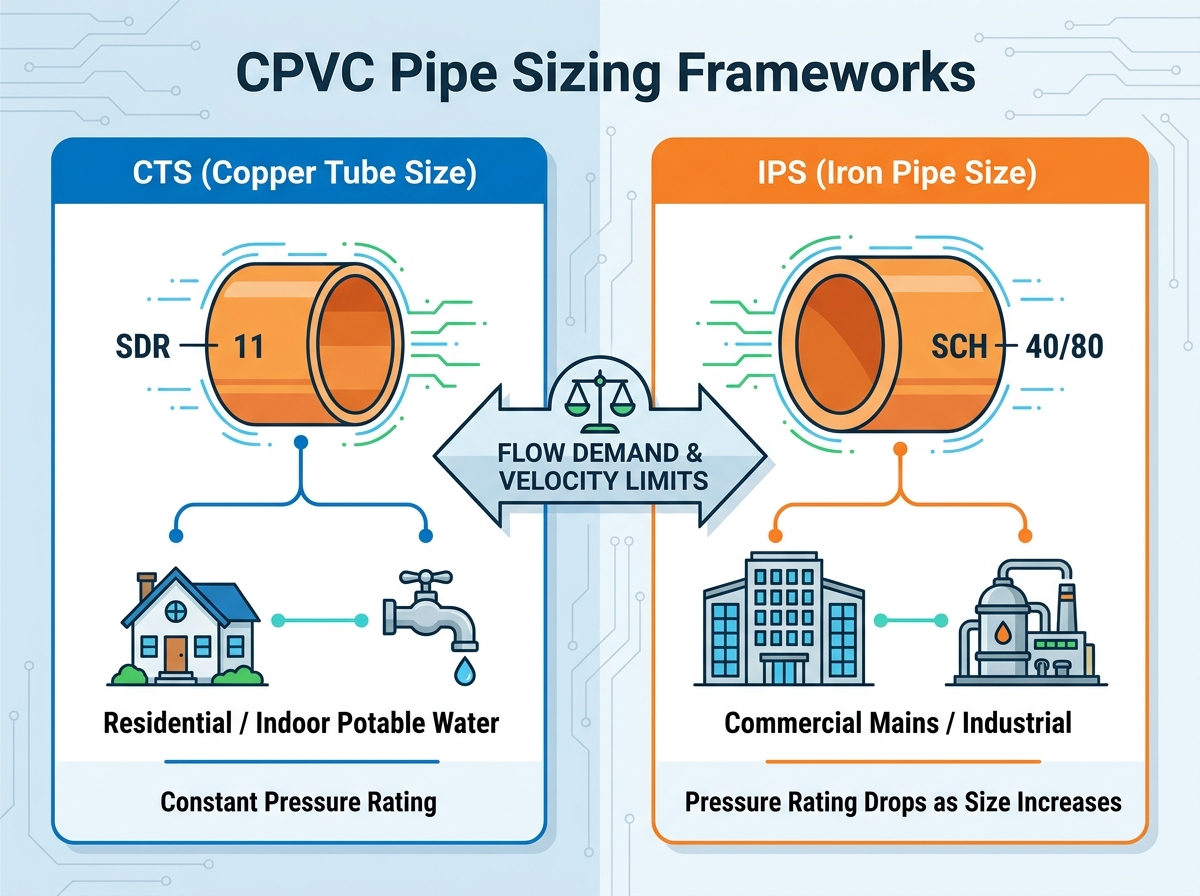
Standards Matter: Sizing depends entirely on the system framework—most building plumbing utilizes Copper Tube Size (CTS) SDR 11, while larger mains may require Iron Pipe Size (IPS) Schedule 40/80.
Velocity is the Limit: Proper sizing must balance Water Supply Fixture Units (WSFU) against a maximum flow velocity (typically 8 ft/sec) to prevent system degradation.
Beware the Undersize Trap: Directly substituting nominal sizes from older systems without accounting for CPVC's specific Inside Diameter (ID) and wall thickness can lead to severe pressure drops.
Vendor Capabilities: Partnering with a certified CPVC pipe supplier ensures ASTM/NSF compliance and opens access to custom CPVC pipe solutions for complex layouts.
The Sizing Frameworks: CTS vs. IPS Standards
Define Copper Tube Size (CTS)
Copper Tube Size serves as the primary standard for indoor hot and cold potable water distribution. These pipe sizes typically range from 1/2-inch to 2-inch diameters. The industry utilizes a Standard Dimension Ratio (SDR) 11 for this framework. SDR indicates a constant ratio between the outside diameter and the wall thickness. Because this ratio remains constant, the pressure rating remains consistent across all pipe sizes. You can expect a rating of 400 psi at 73°F. This rating drops to 100 psi at 180°F. This uniform pressure capability makes CTS highly reliable for residential networks.
Define Iron Pipe Size (IPS)
Iron Pipe Size applies to much larger commercial risers, industrial applications, and primary water mains. These pipe sizes span from 1/2-inch all the way up to 24 inches. The IPS framework generally utilizes Schedule 40 and Schedule 80 designations. Unlike the SDR framework, IPS pressure ratings drop as the pipe diameter increases. A 2-inch Schedule 80 pipe handles significantly less pressure than a 1/2-inch Schedule 80 pipe. Engineers must carefully consult pressure derating charts when specifying IPS materials for high-rise buildings or heavy-duty industrial plumbing.
Decision Lens
You must match the structural framework to your specific application. Residential homes and multi-family apartments usually require CTS SDR 11. These environments demand consistent hot water delivery at moderate pressures. Large-scale commercial projects often demand a hybrid approach. You might specify an IPS Schedule 80 network for the main vertical risers. You would then transition to CTS SDR 11 for the individual floor branches. Selecting the right building plumbing CPVC pipe framework prevents catastrophic pressure failures downstream.
Step-by-Step Sizing Logic for Building Plumbing
Calculate Water Supply Fixture Units (WSFU)
Proper sizing always begins by calculating the Water Supply Fixture Units. Standard plumbing codes like the UPC and IPC assign specific WSFU values to every plumbing fixture. A standard toilet possesses a different value than a commercial kitchen sink. Showers, bathtubs, and dishwashers all contribute to the total load. You must tally the WSFU for every fixture connected to the branch or main line. This cumulative number represents the theoretical maximum demand placed on your plumbing network.
Convert WSFU to Gallons Per Minute (GPM)
Once you calculate the total WSFU, you must convert this figure into Gallons Per Minute. Engineers typically use Hunter’s Curve or modernized plumbing code tables for this conversion. This step determines the peak demand. Peak demand rarely assumes every single fixture runs simultaneously. Instead, it calculates the statistical probability of simultaneous use. Accurately determining the GPM ensures you do not oversize the pipe needlessly. Oversizing leads to stagnant water and potential bacterial growth.
Factor in Velocity Limits
Velocity limits represent a critical engineering rule. You must maintain water velocity below 8 feet per second (ft/s) for cold water distribution. Hot water networks require an even stricter limit of 5 ft/s. Fast-moving water generates severe hydraulic shock, commonly known as water hammer. This phenomenon damages fittings, valves, and joints over time. High-velocity hot water also accelerates erosion corrosion inside the pipe. If your calculated GPM pushes the velocity past these limits, you must increase the pipe diameter immediately.
Account for Friction Loss
Water loses pressure as it travels through a pipe. Engineers use the Hazen-Williams formula to calculate this friction loss over the length of the run. CPVC boasts a Hazen-Williams C-factor of 150. This exceptionally smooth interior surface reduces friction significantly. Legacy metal pipes often have a C-factor of 100 or lower. The smooth inner wall allows water to flow more freely. You can often maintain higher flow rates over longer distances. Always factor in the pressure drop caused by elbows, tees, and vertical lifts.
Essential CPVC Pipe Specifications and Tolerances
Nominal vs. Actual Dimensions
Consulting accurate CPVC pipe specifications prevents flow restriction. Engineers frequently make errors by designing networks based on nominal sizes. Nominal size acts only as an industry label. You must base your flow calculations on the actual Inside Diameter (ID). The wall thickness directly impacts the internal space available for water flow. A pipe possessing a thicker wall will have a smaller ID. This smaller ID changes your velocity and friction loss calculations dramatically.
Standard Dimensional Comparison for Engineering Reference
Nominal Size | CTS SDR 11 Actual ID (Approx.) | IPS Sch 80 Actual ID (Approx.) | Application Focus |
|---|---|---|---|
1/2 inch | 0.489 inches | 0.526 inches | Individual fixture branches |
3/4 inch | 0.715 inches | 0.722 inches | Multi-fixture bathrooms |
1 inch | 0.921 inches | 0.936 inches | Small residential mains |
2 inch | 1.799 inches | 1.913 inches | Commercial risers / Large mains |
Thermal Expansion Allowances
CPVC expands significantly when exposed to heat. The material grows approximately 1 inch per 50 feet of pipe during a 50°F temperature change. You must account for this movement during the sizing and layout phase. Pipe size directly dictates the required length of expansion loops or offsets. Larger diameter pipes require longer offset legs to safely absorb the thermal stress. Failing to provide adequate expansion allowances causes the pipe to buckle. This structural stress leads to premature joint failure.
Standard Compliance
You cannot compromise on standard compliance. The plumbing code mandates specific certifications for structural integrity and health safety. CTS materials must comply with ASTM D2846. Iron Pipe Size materials must meet ASTM F441 requirements. Furthermore, any pipe carrying potable water must carry NSF/ANSI 14 and 61 certifications. These NSF standards verify the material does not leach harmful chemicals into the drinking water. Specifying uncertified materials guarantees a failed building inspection.
Troubleshooting: The Risks of Undersized CPVC Pipe
The "Retrofit" Error
Plumbing retrofits present massive sizing traps. Contractors frequently swap a 3/4-inch galvanized metal pipe directly for a 3/4-inch CPVC pipe. They perform this swap without verifying the internal diameter. Galvanized pipes often possess a larger actual ID than CTS CPVC. This direct substitution leads to volume starvation at the fixture. The end-user turns on the shower and receives a weak, unsatisfactory trickle. You must recalculate the entire branch load before selecting a replacement pipe size.
Fittings and Bottlenecks
Poor installation practices compound undersizing issues. Installers must cut pipes squarely and ream the ends properly. An unreamed pipe end creates a sharp internal ridge. This ridge causes turbulence and restricts water flow. Furthermore, excessive solvent cement creates severe bottlenecks. When an installer applies too much cement, it pushes into the pipe interior during assembly. The cement hardens into a solid obstruction. You must train installation crews to apply cement sparingly and evenly.
System Symptoms
How do you identify an undersized network in a finished building? The symptoms usually manifest quickly. End-users often experience severe scalding when someone flushes a toilet nearby. You might hear the pipes whistling loudly during peak usage hours. Rapid temperature fluctuations also indicate a fundamental lack of water volume. These warning signs show the network cannot handle simultaneous demand. These symptoms require immediate engineering intervention and often necessitate localized repiping.
Procurement Criteria: Evaluating a CPVC Pipe Supplier
Quality Assurance & Traceability
Choosing a reliable CPVC pipe supplier guarantees long-term system stability. You should source materials from manufacturers offering transparent lot testing. Rigid adherence to ASTM standards separates premium vendors from unreliable brokers. A trustworthy supplier provides documented proof of material compliance upon request. Traceability allows engineers to track a specific pipe batch back to its original resin mix. This accountability proves essential during large-scale commercial installations and municipal compliance audits.
Custom Fabrication and Sizing
Standard off-the-shelf sizes sometimes fall short of project requirements. Complex mechanical rooms or unique architectural layouts demand specialized solutions. Seek vendors possessing the ability to produce custom CPVC pipe lengths. Some advanced suppliers can even manufacture specific wall thicknesses for unique pressure scenarios. Pre-fabricated assemblies also represent a massive advantage. Procuring custom headers or manifolds directly from the factory reduces on-site labor drastically. It also minimizes the risk of human error during assembly.
Technical Support
Evaluate vendors heavily based on their engineering resources. A premium supplier acts as a technical partner, not just a material distributor. They should supply comprehensive submittal packages for your engineering team. Ask them to provide specific pressure derating charts for elevated temperatures. Request chemical compatibility data if the pipe will route near industrial solvents or harsh cleaning agents. Excellent technical support helps you navigate complex sizing challenges before installation begins.
Conclusion
Sizing CPVC remains an exact science. You must carefully balance flow demand, velocity limits, and standard dimensional ratios. Choosing between CTS and IPS frameworks dictates the overall pressure capabilities of your network. Always base your calculations on the actual inside diameter rather than nominal labels. Careful specification upfront prevents catastrophic compliance failures and destructive water hammer. We highly encourage estimators and mechanical engineers to reach out to certified suppliers early. Submitting your blueprints or RFQs for expert sizing verification ensures you receive the correct materials direct to your job site.
FAQ
Q: Can I use Schedule 40 CPVC for indoor residential building plumbing?
A: While physically possible, CTS SDR 11 is the industry standard and code requirement for residential hot/cold potable water. Schedule 40/80 is typically reserved for commercial mains, chilled water, or industrial fluid handling.
Q: How do I convert metric pipe requirements to standard CPVC sizes?
A: Metric conversions require cross-referencing precise OD/ID charts, as a straight millimeter conversion of the nominal size will not align with standard ASTM fittings. (Recommend consulting a supplier's spec sheet).
Q: Does CPVC require a larger nominal size than copper to deliver the same flow?
A: Not necessarily. CTS CPVC has the same outside diameter as copper tube, but a slightly thicker wall. While the ID is marginally smaller, CPVC's smoother interior (higher Hazen-Williams C-factor) often offsets friction loss, resulting in comparable flow rates.