



How to Plan Water Supply Fitting Installation for Municipal Plumbing?


Municipal plumbing projects carry a zero-tolerance policy for catastrophic failures. The massive gap between an adequate installation and a highly resilient one lies entirely during the procurement and planning phase. A single failed underground connection can disrupt essential service for thousands of local residents. Upgrading or extending complex city water grids requires navigating extremely stringent regulatory standards. System designers must account for legacy infrastructure compatibility alongside high-pressure daily system demands. Every piece of pipeline hardware must perform flawlessly under immense environmental strain. This guide provides a definitive framework for evaluating critical components and mapping implementation risks. We will help you navigate complex civic requirements to select reliable procurement partners for large-scale municipal pipeline projects. You will learn how to identify proper material grades and establish fail-proof installation protocols.
Key Takeaways
Success in municipal installations hinges on matching specific pressure ratings and material grades to local soil and water chemistry.
Regulatory compliance (e.g., AWWA, NSF/ANSI 61) is non-negotiable and must be verifiable through your supply chain.
Retrofitting century-old city grids often necessitates tailored fabrication rather than off-the-shelf components.
Vetting a partner requires moving beyond unit cost to evaluate material traceability, lead-time reliability, and technical support.
Framing the Scope: Success Criteria for Municipal Water Installations
Municipal grids face unique and brutal operational hurdles constantly. These include fluctuating hydrostatic pressures, severe water hammer effects, and extreme external load stresses. Residential plumbing setups simply do not encounter this immense level of strain. Heavy commercial traffic above ground creates constant destructive vibration. These vibrations slowly compromise standard pipe threads over time. Sudden civic valve closures send massive shockwaves through the complex underground network. We must proactively design for these harsh physical realities from day one.
We measure municipal project success against strict baseline performance metrics. Planners expect a 50-year minimum projected lifecycle for underground assets. This operational demand requires nearly zero maintenance interventions over several decades. Installations must also achieve zero compliance violations during official governmental inspections. Third-party structural and safety audits will aggressively test every connection point. Inspectors look closely for any signs of premature material fatigue. You need highly predictable procurement schedules to maintain forward momentum. Reliable delivery timelines directly prevent municipal service downtime and costly contractor delays.
Evaluating underground components requires a strictly long-term functional perspective. Upfront hardware pricing represents a tiny fraction of total project expenditure. Major municipal expenses arise from deep-trench excavation and specialized heavy equipment operation. Labor costs skyrocket when teams must execute unexpected failure remediation or emergency street patching. Selecting a premium water supply fitting prevents emergency pipe bursts effectively. Preventative planning directly safeguards civic budgets against catastrophic excavation rework. Focusing purely on structural durability eliminates repeated digging in heavily populated urban centers.
Decoding Water Supply Fitting Specifications for City Grids
Selecting the correct materials prevents rapid underground infrastructure degradation. Planners must evaluate ductile iron, high-density polyethylene (HDPE), and heavy-duty brass carefully. You choose these materials based on soil corrosivity and existing pipeline composition. Connecting modern upgrades to legacy systems introduces major chemical risks. You must address the serious threat of galvanic corrosion. This happens frequently when joining dissimilar metals inside older city grids. Using dielectric unions or specialized protective coatings stops rapid metal deterioration.
System longevity depends entirely on strict pressure and physical load tolerances. Mainline and service distribution networks require exceptionally high baseline working pressure ratings. Expect standard municipal requirements to range strictly from 250 psi to 350 psi. Surges can easily exceed normal operating limits during peak neighborhood usage or fire hydrant activation. You must utilize accurate water supply fitting specifications to prevent surge-related blowouts. Proper pressure ratings guarantee the distribution system absorbs sudden spikes safely. Engineers often calculate required surge allowances using advanced fluid dynamics software.
Strict regulatory alignment directly protects local public health and municipal liability. Municipal projects operate under mandatory and uncompromising compliance frameworks. You must ensure absolute alignment with AWWA (American Water Works Association) standards for installation protocols. Engineers must also strictly verify NSF/ANSI 61 and 372 compliance. These crucial certifications guarantee completely safe, lead-free potable water distribution. Independent lab testing should validate every component batch before installation begins. Facilities often issue digital certificates confirming safe toxicity levels for municipal records.
Material Type | Primary Municipal Application | Corrosion Resistance Level | Lifespan Expectancy |
|---|---|---|---|
Ductile Iron | High-pressure mainlines under heavy traffic | Moderate (requires polywrap in acidic soil) | 50+ years |
HDPE | Trenchless installations and directional drilling | Excellent (immune to galvanic corrosion) | 50 - 100 years |
Heavy-Duty Brass | Service line connections and precise metering | High (dezincification resistant alloys needed) | 40 - 60 years |
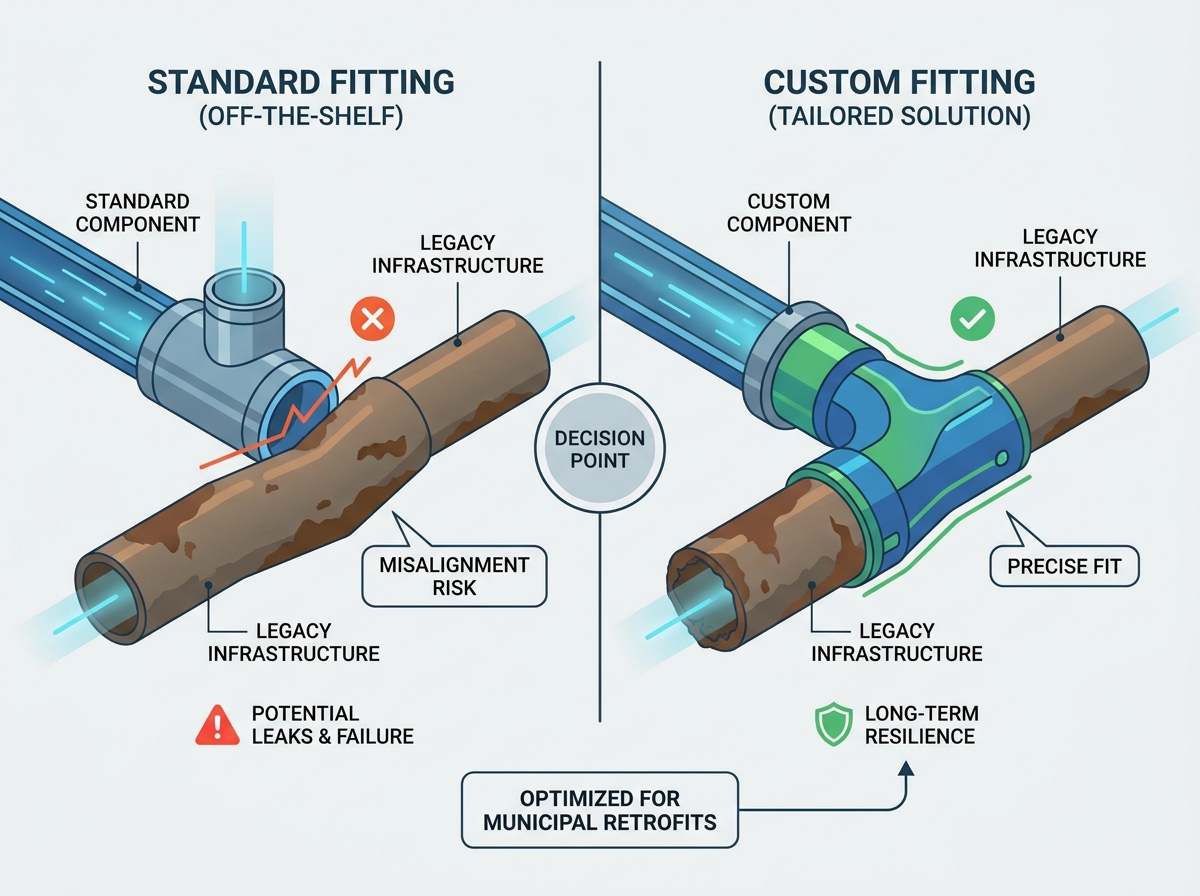
Standard vs. Custom Water Supply Fitting: Evaluating the Right Approach
Standardized angles and factory dimensions frequently fail in older cities. Off-the-shelf hardware struggles significantly when tying into unmapped historical municipal infrastructure. Century-old pipes often shifted dramatically over decades of ground settling. Standardized components cannot accommodate highly unusual angles or severely deteriorated connection points. Forcing standard parts into misaligned spaces creates immediate and dangerous stress fractures.
Specific urban scenarios demand specialized engineering and unique fabrication. You must specify a custom water supply fitting when dealing with non-standard transition couplings. Transitioning between imperial and metric pipe outside diameters requires exact machining. High-stress directional junctions also require reinforced or specialized internal restraint mechanisms. Tailored components eliminate weak points in critical pipeline directional changes. Engineers typically use advanced CAD software to design these exact joint tolerances.
We must conduct a thorough and realistic cost-to-benefit analysis here. Custom engineered components inherently require extended manufacturing lead times. Facilities need time for pattern making, casting, and precision machining. They also carry additional upfront engineering and design costs. However, you must carefully weigh these factors against severe structural risks. Forcing standardized hardware into misaligned underground joints drastically increases daily labor costs. Tailored solutions ensure much faster, significantly safer installation once the trench opens. You avoid paying expensive labor crews to wrestle with ill-fitting connections.
Mitigating Implementation Risks in Municipal Plumbing Water Supply Fitting
Proper implementation planning requires analyzing multiple pre-installation site variables thoroughly. Engineering teams must rigorously assess detailed local geotechnical reports. You need to understand soil shifting, precise frost line depths, and daily traffic loads. Cold climates require burying hardware well below the regional frost line. This strictly prevents dangerous freezing expansion during deep winter months. Frozen ground expands powerfully, easily crushing inadequate pipes. Planners must design effective thrust restraints based on pipeline direction changes. Mechanical joint restraints often replace traditional concrete thrust blocks in modern cities. Mechanical options offer far superior flexibility in unstable or shifting soils. They also require much less space inside narrow urban trenches.
Executing the installation involves complex neighborhood staging and integration realities. Municipalities face massive logistical challenges when scheduling neighborhood water shutoffs. You must minimize public disruption and closely coordinate local emergency services. Integrating a new municipal plumbing water supply fitting into an active grid demands extreme precision.
Planners often utilize hot tapping procedures to avoid total neighborhood shutdowns. Consider these primary integration steps:
Install a heavy-duty tapping sleeve directly onto the existing pressurized main.
Attach a permanent municipal gate valve to the new tapping sleeve securely.
Mount the specialized hot tapping machine directly onto the open gate valve.
Cut the pipe section carefully while maintaining full system water pressure.
Retract the cutting bit, close the valve, and remove the tapping machine.
Rigorous field validation protocols finalize the entire installation phase safely. Establishing mandatory hydrostatic pressure testing remains critical before commissioning any pipeline. Contractors push the network briefly beyond normal operating limits. This deliberately exposes any hidden microscopic leaks before burying the hardware. Following pressure validation, teams execute strict chlorination and disinfection protocols. Public health mandates absolutely require thorough flushing and bacterial testing daily. Technicians take multiple water samples for lab analysis. You must clear these tests before connecting the grid to residential homes. Failing to properly disinfect the new line invites severe regulatory penalties.
Shortlisting and Vetting a Water Supply Fitting Supplier
Procurement decisions directly define the overall long-term safety of the grid. You must demand absolute traceability and strict certification audits from vendors. Require suppliers to provide comprehensive mill test reports (MTRs) for every single delivery. These documents list exact heat numbers and specific chemical compositions. Planners must also request independent lab certifications for every batch of hardware. Documenting material origins prevents counterfeit or substandard metals from entering the municipal system. This rigorous paperwork tracking protects your municipality from future liability claims.
Project timelines rely heavily on inventory depth and lead-time reliability. You must evaluate the domestic warehousing capacity of your chosen water supply fitting supplier carefully. Robust local inventory immediately prevents project-halting delays caused by global shipping bottlenecks. Reliable partners consistently hold safety buffer stock for critical civic infrastructure components.
Credible manufacturing partners offer significant engineering and technical support constantly. A true partner provides comprehensive pre-sale blueprint specification reviews. They assist with on-site installation troubleshooting instead of just offering transactional order fulfillment.
Outline a clear Request for Proposal structure to demand precise technical data. Here is a recommended vendor evaluation framework:
Technical Data Verification: Demand exact burst pressure ratings and certified material grades upfront.
Quality Assurance Documentation: Require verifiable proof of AWWA and NSF/ANSI 61 compliance.
Long-Term Warranty Terms: Secure comprehensive financial coverage for extended defect remediation.
Phased Volume Pricing: Establish transparent cost structures for large-scale, multi-year pipeline rollouts.
Reliable Delivery Schedules: Mandate strict penalty clauses for any delayed component fulfillment.
Conclusion
Effective municipal plumbing installations require an uncompromising approach to specification matching. Teams must prioritize rigorous risk mitigation and strict regulatory adherence at every stage. Successful projects balance advanced material science against the physical realities of underground environments. Properly addressing soil corrosivity and hydrostatic pressure ensures decades of reliable service.
The true durability of a city's water infrastructure is ultimately determined early. It happens long before the trench is ever dug. It relies entirely on the critical evaluation of components and trusted supply partners.
We prompt procurement officers and municipal engineers to take immediate proactive steps. Request a deep technical consultation or submit your complex project blueprints today. Scheduling a comprehensive specification audit guarantees your next installation meets all strict municipal standards.
FAQ
Q: What are the required compliance standards for municipal potable water fittings?
A: Municipal fittings must adhere strictly to NSF/ANSI 61 standards, which limit harmful chemical leaching. They also require NSF/ANSI 372 certification for lead-free compliance. Additionally, hardware must meet rigorous AWWA design standards and align fully with the federal Safe Drinking Water Act.
Q: How do you prevent galvanic corrosion when retrofitting older city water lines?
A: You prevent galvanic corrosion by isolating dissimilar metals physically. Engineers install specialized dielectric unions or highly durable insulating flange kits. Applying specific thick protective epoxy coatings or utilizing sacrificial anodes also protects vulnerable legacy iron pipes from rapid deterioration.
Q: What is the standard lead time for a custom water supply fitting in large-scale projects?
A: Standard lead times for custom-engineered municipal components typically range from 6 to 12 weeks. This timeframe heavily depends on engineering complexity, raw material availability, and necessary CNC machining time. Planners must factor this duration into early project staging carefully.
Q: Why are mechanical joint restraints preferred over thrust blocks in modern municipal installations?
A: Mechanical joint restraints offer superior labor efficiency and require significantly less trench space. Urban trenches are often highly congested with existing utility lines. Mechanical restraints securely lock pipes together, offering much better long-term reliability against soil shifting than poured concrete blocks.