


What Maintenance Cuts Custom Pipe Fitting Downtime?


Unplanned piping system downtime strikes facilities hard. It translates directly to massive lost revenue and severe production bottlenecks. You also face potential safety hazards when pressurized systems fail unexpectedly. Off-the-shelf parts often crack under unique industrial stresses. However, custom solutions offer a distinct advantage. We view these items not just as simple installation fixes. They function as highly engineered components. These complex parts require specific, proactive lifecycle management. Proper care ensures they continuously outperform standard alternatives. This article serves a very clear purpose. We provide facility managers and procurement officers with actionable strategies. You will discover an evidence-based maintenance framework. We outline precise decision criteria for your daily operations. You can leverage these tools immediately. Doing so will drastically minimize unexpected operational halts.
Key Takeaways
Proactive condition monitoring and scheduled replacement intervals drastically reduce catastrophic blowout risks in custom plastic systems.
Adhering strictly to original custom plastic pipe fitting specifications prevents compatibility-driven wear and chemical degradation.
Strategic bulk procurement custom plastic pipe fitting plans ensure critical spares are on hand for rapid turnarounds, mitigating supply chain delays.
Selecting a technically transparent custom plastic pipe fitting supplier is just as critical to minimizing downtime as the physical maintenance routine itself.
The Financial Impact of Reactive vs. Proactive Pipeline Management
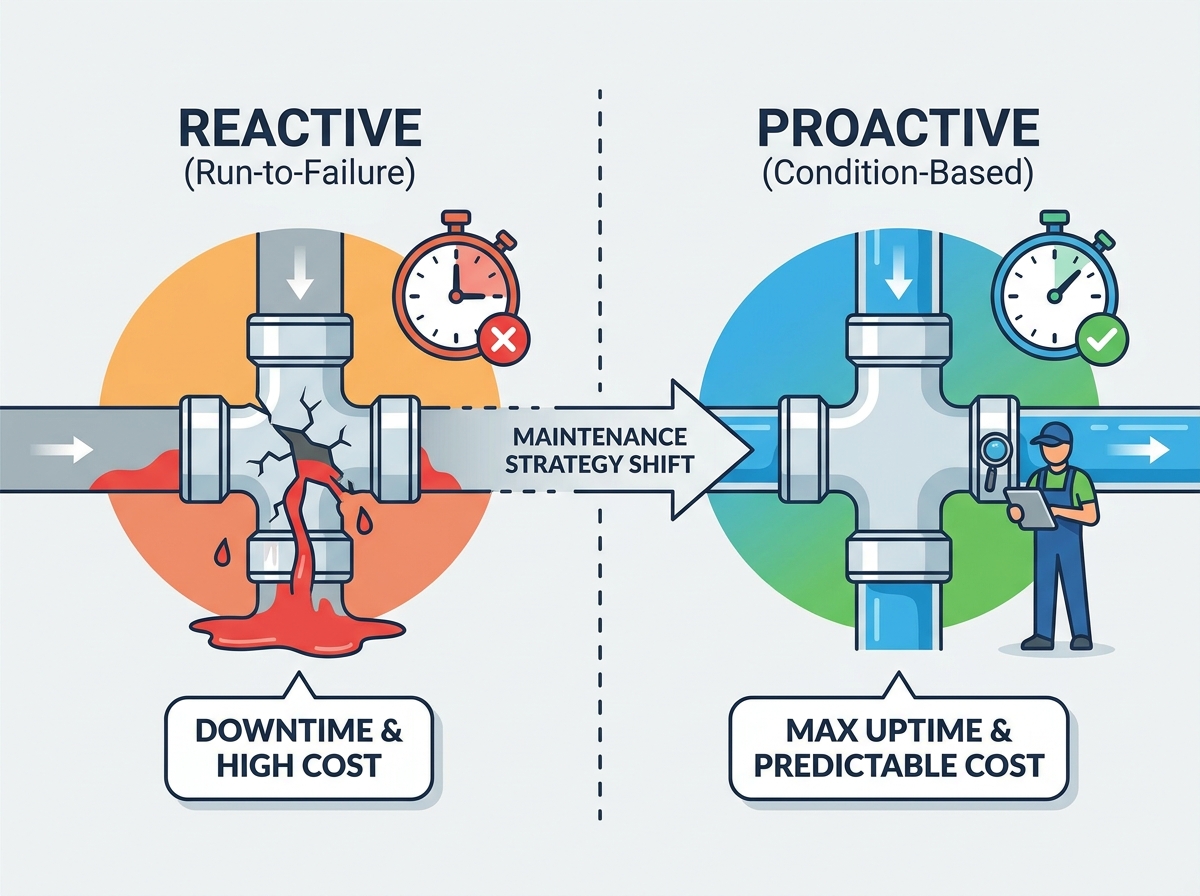
Reactive maintenance drains facility budgets rapidly. You essentially wait for a component to break completely. Then, you shut down entire operations to fix it. This run-to-failure model creates massive compounding costs. Emergency repairs demand expensive overnight parts shipping. Production workers sit idle during these unexpected halts. You also risk missing critical delivery deadlines for your clients. Conversely, proactive condition-based maintenance changes everything. It offers predictable and highly controlled operational costs. You schedule essential repairs during planned facility downtimes. You never disrupt peak production hours.
Industrial piping faces multiple severe failure modes. Thermal expansion stress warps rigid polymer lines over time. Chemical embrittlement silently weakens internal molecular structures. Sudden pressure surges easily crack these weakened joints. If you ignore these early warning signs, catastrophic failure becomes inevitable. You risk toxic spills and severe workplace injuries.
What does true operational success look like? We define it through three primary metrics. First, you observe highly predictable wear patterns across all lines. Second, you achieve absolutely zero unscheduled halts throughout the year. Third, you maintain verifiable audit trails for every component. These detailed trails ensure strict regulatory compliance. They also prove your dedication to worker safety.
Maintenance Strategy Comparison Chart
Maintenance Strategy | Cost Predictability | Unplanned Downtime Risk | System Lifespan Impact |
|---|---|---|---|
Reactive (Run-to-Failure) | Extremely Low | Very High | Significantly Shortens System Life |
Preventative (Time-Based) | Medium | Moderate | Maintains Baseline Expectations |
Predictive (Condition-Based) | Very High | Extremely Low | Maximizes Component Longevity |
Core Maintenance Protocols for a Custom Plastic Pipe Fitting
Every customized fluid system requires strict, dedicated upkeep. A tailored custom plastic pipe fitting demands specific inspection protocols. You must move far beyond basic visual checks. We recommend implementing a multi-layered diagnostic approach.
Routine visual inspections remain your critical first defense. Technicians should look for microscopic stress crazing daily. They must spot early material discoloration immediately. Micro-cracking in plastic components always signals impending structural failure. However, Non-Destructive Testing provides much deeper engineering insights. Ultrasonic thickness gauges detect internal wall thinning accurately. They reveal hidden wear without halting your fluid flow.
Torque and flange management prevents disastrous system leaks. Polymer-based networks undergo constant cyclic loading during operation. This rhythmic stress causes gradual flange deformation. Weeping joints frequently result from improper bolt tension. You must verify fastener torque settings regularly. Use properly calibrated mechanical tools to tighten bolts evenly. Never rely on manual guessing for high-pressure systems.
Environmental and chemical audits prevent rapid material degradation. Your original system design relies on very specific media parameters. Has the fluid temperature increased recently? Did the chemical concentration change during a new process? You must verify these critical factors constantly. Any deviation beyond original design limits causes rapid decay. You should install automated sensors to track these metrics continuously.
Thorough documentation ties your entire maintenance effort together. Logging inspection data helps you identify subtle wear trends. You can spot a failing part months early. We strongly advise digitizing all maintenance records immediately. This strategy prevents minor oversight from becoming catastrophic operational failures.
How Exact Custom Plastic Pipe Fitting Specifications Prevent Premature Wear
Absolute precision matters deeply in industrial fluid dynamics. Standard off-the-shelf parts often force terrible system compromises. They require unnatural pipe bending just to fit properly. This forced alignment creates severe localized stress points. Suboptimal flow dynamics lead to internal liquid turbulence. Premature material fatigue eventually destroys the compromised joint. You lose valuable production time fixing avoidable errors.
Matching specific materials to applications solves this core issue. You must evaluate exact polymer grades carefully. PVC handles general municipal water distribution exceptionally well. CPVC withstands much higher temperature flows effectively. PVDF excels against highly aggressive industrial acids. PTFE provides ultimate chemical inertness for extreme environments. You must align the chosen material with your operational realities. Consider long-term UV exposure and maximum pressure ratings carefully.
Strict adherence to engineered custom plastic pipe fitting specifications guarantees long-term success. Tight manufacturing tolerances matter immensely in pressurized networks. A properly engineered custom custom plastic pipe fitting eliminates excess vibration completely. It reduces internal fluid friction significantly across the network. This engineered precision directly lowers your monthly maintenance burden. The entire fluid system enjoys a much longer operational lifespan.
Steps for Specification Alignment
Audit your current system operating pressures and peak temperatures.
Cross-reference media chemicals against detailed polymer resistance charts.
Verify tight dimensional tolerances for all critical connection points.
Update facility CAD models to reflect any recent plant modifications.
Consult specialized materials engineers before altering fluid concentrations.
Inventory as Maintenance: Bulk Procurement Custom Plastic Pipe Fitting Strategies
Strategic inventory management directly impacts your maintenance success. Turnaround readiness requires having physical replacement parts on site. A scheduled pipe fabrication turnaround fails instantly otherwise. You cannot wait weeks for backordered specialized components. Having physical replacements ready mitigates extended operational downtime. You restore production capacity in hours instead of days.
Proactive strategic stocking simply makes strong economic sense. You must build an on-site critical spares inventory today. Executing a smart bulk procurement custom plastic pipe fitting plan protects your facility. You order highly specialized parts well in advance. This approach shields your operations from global supply chain shocks. It ensures your maintenance teams can act immediately during emergencies.
Shelf-life considerations dictate your proper warehouse storage methods. Plastic fittings degrade quickly if stored improperly. Environmental exposure weakens the polymer before installation even begins. We strongly recommend following evidence-based warehouse storage guidelines.
Keep all polymer components away from direct UV sunlight.
Store sensitive fittings in tightly climate-controlled indoor environments.
Avoid extreme temperature fluctuations within your primary warehouse.
Keep specialized parts in their original sealed packaging until needed.
Implement a strict First-In, First-Out (FIFO) usage rotation policy.
Conduct quarterly physical audits to discard expired rubber gaskets.
Following these specific rules keeps your bulk inventory field-ready.
Shortlisting Your Custom Plastic Pipe Fitting Supplier for Long-Term Reliability
Your chosen vendor directly influences your daily operational continuity. You must evaluate potential partners across several key dimensions. A strong, transparent relationship prevents major logistical headaches later. You need a partner, not just a transactional seller.
Technical transparency remains absolutely non-negotiable in this industry. Look for a trusted custom plastic pipe fitting supplier who shares data freely. They should provide comprehensive material testing results upon request. Ask for their detailed pressure derating curves immediately. They must offer clear, actionable maintenance documentation for every part. Opaque vendors usually hide inferior manufacturing processes and cheap materials.
Extensive prototyping and strict quality assurance prove their actual capabilities. Assess their internal factory quality control protocols strictly. Verify their current ISO certifications and ASTM standards compliance. This rigorous check ensures perfect batch-to-batch consistency. You need replacement parts that match perfectly every single time. A slight dimensional variance causes massive leaks.
Take immediate next-step actions to verify their engineering skills. Initiate a small, low-risk pilot project first. Request a comprehensive engineering audit of your current plant setup. Test their physical lead times and daily communication habits. Evaluate their technical acumen and problem-solving speed carefully. Do this thorough vetting before committing to facility-wide integration.
Supplier Evaluation Checklist
Evaluation Area | Key Indicators of Reliability | Red Flags to Avoid |
|---|---|---|
Quality Assurance | ASTM/ISO certified, provides raw test data | Refuses to share material origins or test results |
Engineering Support | Offers custom CAD modeling, custom pressure curves | Only functions as a middleman product broker |
Supply Chain Logistics | Offers local stock holding programs, clear lead times | Demonstrates frequent delays, remains uncommunicative |
Customer Service | Provides rapid emergency response protocols | Fails to return technical inquiries within 24 hours |
Conclusion
Custom tailored fittings represent a major investment in operational efficiency. This financial investment only yields maximum returns under specific conditions. You must pair high-quality parts with aggressive, proactive maintenance routines. Smart inventory management plays an equally vital role in your success. Ignoring these crucial factors guarantees unexpected system failures and lost revenue.
Take decisive action today to protect your critical infrastructure. Audit your current fluid system specifications thoroughly this week. Review your on-site critical spares inventory immediately. Identify any missing crucial components for your high-risk lines. Contact your dedicated engineering support team right away. Ask them to evaluate your current fitting performance formally. These simple, proactive steps will drastically cut your future downtime.
FAQ
Q: What is the standard inspection frequency for industrial custom plastic fittings?
A: Inspection frequency depends entirely on your specific operational environment. Harsh chemical applications require strict monthly visual checks. Mild water distribution systems may only need quarterly reviews. Always combine visual inspections with annual ultrasonic non-destructive testing for the best safety results.
Q: Can a damaged custom plastic fitting be repaired, or must it be replaced?
A: We strongly advise against repairing compromised structural fittings. Plastic welding works for minor cosmetic fixes on non-pressurized drainage tanks. However, pressurized pipeline integrity demands absolute complete replacement. Patching damaged sections creates dangerous weak points that invite disastrous blowouts.
Q: How do temperature fluctuations impact the maintenance schedule of plastic piping?
A: Temperature swings cause significant thermal expansion and contraction. This continuous physical movement stresses the rigid polymer joints heavily. Rapid thermal fluctuations accelerate daily wear and loosen flanged connections. You must increase your torque verification frequency in highly volatile temperature environments.
Q: Why should we source fully customized parts instead of adapting standard ones?
A: Customized parts eliminate internal flow restrictions and unnatural bending stress. Standard parts force physical compromises that create internal turbulence and friction. Engineered solutions ensure perfect structural alignment. This drastically improves flow efficiency, reduces physical stress, and extends your overall system life.