



PVC Plumbing Pipe: A Bulk Buyer Checklist


Procuring commercial volumes of piping demands intense focus from buyers. A single oversight can trigger massive delays. It can also blow up critical project margins. Sourcing at scale involves much more than finding the lowest unit price. You must mitigate risk, ensure code compliance, and maintain a strict timeline. Inconsistent wall thickness frequently derails large-scale plumbing installations. Supply chain friction and non-compliant batch runs create massive site bottlenecks. When a shipment fails inspection, job sites shut down. Labor forces sit idle while waiting for replacements.
This guide provides a purely operational checklist for your next bulk order. You will learn exactly how to evaluate materials. We explain how to assess manufacturing partners. We also cover how to finalize purchase agreements safely. By following these steps, you can secure reliable shipments. You will avoid catastrophic failures on site. Our focus remains strictly on procurement mechanics and quality assurance.
Key Takeaways
Verify specs strictly: Ensure all batches meet standard ASTMs (e.g., D1785, D2665) to prevent catastrophic fitting mismatches on site.
Vet supplier infrastructure: The lowest price is a liability if the supplier lacks robust QA/QC documentation and reliable freight logistics.
Application matching is critical: Standard residential requirements differ fundamentally from custom or high-pressure industrial needs.
Inspect upon arrival: Implement a strict inbound freight checklist to catch micro-fractures or UV degradation before signing the Bill of Lading.
Defining Your Baseline: PVC Plumbing Pipe Specifications
Evaluating your baseline requirements starts here. You need absolute clarity on what materials your project actually demands. We categorize these choices by wall thickness, core structure, and mandatory certifications. Understanding these physical limits prevents costly field failures.
Schedule 40 vs. Schedule 80
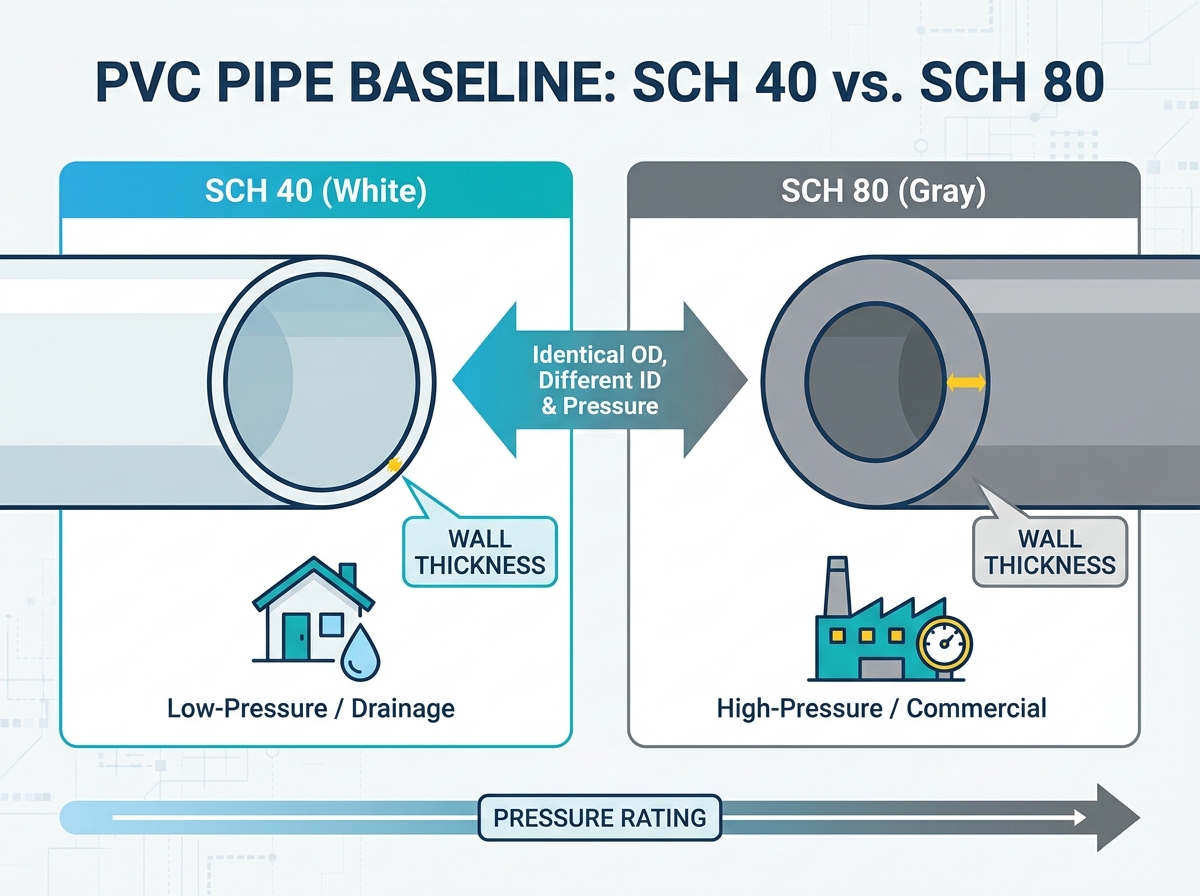
Engineers define the evaluation framework based on system pressure. Schedule 40 usually features a white finish. You use it for standard drainage and low-pressure water systems. Schedule 80 comes in gray. It handles high-pressure commercial demands. Note an important rule here. The Outer Diameter (OD) remains identical across both schedules for a given nominal size. However, the Inner Diameter (ID) shrinks on Schedule 80 to accommodate thicker walls. This restricted ID directly dictates flow rates. Plumbers rely on consistent OD to utilize standard fittings. If you install Schedule 80, you must recalculate fluid velocity. Thicker walls mean reduced interior volume.
Solid Wall vs. Cellular Core
You must break down use-case differences carefully. Solid wall pipe provides maximum structural integrity across all applications. Cellular core sandwiches a lightweight foam layer between solid inner and outer walls. We often call this foam core. This construction drastically reduces shipping weight. It also minimizes material expense for Drain, Waste, and Vent (DWV) systems. Plumbers prefer it for gravity-fed drainage. However, cellular core cannot handle pressurized applications. Never use it for pressurized supply lines. It will burst under active water pressure.
Compliance & Certifications
You cannot compromise on PVC plumbing pipe specifications. Building inspectors look for exact print-line marks during rough-in inspections. If you move potable water, require NSF-pw certification. This ensures no harmful chemicals leach into drinking water. If you build drainage systems, specify NSF-dwv. Furthermore, ensure strict adherence to ASTM D1785 for pressure pipes. This covers Schedule 40, 80, and 120. For standard DWV applications, ASTM D2665 serves as the universal standard. Failing to produce these print-lines results in failed municipal inspections.
Pipe Specification Comparison Chart
Pipe Type | Visual Cue | Primary Application | Governing ASTM Standard |
|---|---|---|---|
Schedule 40 | White | Low-pressure, Drainage | ASTM D1785 |
Schedule 80 | Gray | High-pressure, Commercial | ASTM D1785 |
Cellular Core | White | Non-pressure DWV | ASTM F891 / ASTM D2665 |
Material Mapping: Standard vs. Custom Requirements
Matching materials to project environments prevents expensive rework down the line. You must align your bulk order with the precise structural demands of the site. Bulk procurement looks completely different for residential tracts versus industrial parks.
Residential Projects PVC Plumbing Pipe
Housing developments carry unique bulk requirements. Cost-efficiency at scale drives these purchasing decisions. When sourcing residential projects PVC plumbing pipe, you will focus heavily on DWV systems. Municipal codes often dictate noise dampening rules in multi-family units. They also mandate strict fire-stopping measures. You must plan for locations where pipes penetrate fire-rated assemblies. Your material selection must address these local compliance hurdles. Developers typically purchase truckloads of standard lengths. They bundle these shipments alongside massive quantities of common elbows and tees.
Custom PVC Plumbing Pipe Solutions
Industrial jobs or specialized public works push beyond standard catalogs. You might face scenarios requiring non-standard lengths. Custom lengths minimize joint connections over vast distances. Fewer joints mean fewer potential leak points. Some projects demand specialized colors. For example, purple piping universally denotes reclaimed water. Green often indicates sewer lines. Specifying custom PVC plumbing pipe with pre-belled ends drastically reduces field labor. Crews can assemble long runs faster without applying separate couplings. The factory flares one end to accept the next pipe seamlessly.
Fittings Compatibility
You face severe risks if tolerances mismatch. High-volume buyers must scrutinize a single overarching factor. Does your pipe align perfectly with your chosen fittings? Even minor variations in OD tolerances cause systemic joint failures. Solvent cement cannot bridge significant gaps between pipe and fitting. Ensure your core PVC plumbing pipe strictly adheres to the exact same dimensional standards as the fittings manufacturer. Mixing non-vetted brands invites leaks under pressure. Always specify matching ASTMs across your entire procurement list.
Evaluating a PVC Plumbing Pipe Supplier
A bad partner turns a great price into a logistical nightmare. You must audit their manufacturing infrastructure deeply before signing a PO. A thorough supplier audit protects your project timeline.
QA/QC Traceability
An authoritative partner provides transparent batch testing data upon request. You should actively look for burst pressure testing records. Request dimensional verification logs for recent extrusion runs. Do they maintain ISO 9001 compliance? This certification signals rigorous internal quality controls. Strict QA prevents defective batches from reaching your job site. Ask about their defect rate. A reputable factory tracks this metric religiously.
Inventory and Fulfillment Capacity
You must evaluate their safety stock levels. A reliable PVC plumbing pipe supplier buffers against raw resin shortages. The global resin market fluctuates constantly. They carry enough finished inventory to guarantee lead times. This protects your phased rollouts. Ask them how they manage sudden supply chain shocks. If they rely purely on just-in-time manufacturing, you carry the delay risk. Demand guaranteed delivery windows in your contract.
Storage and Handling Practices
UV degradation poses a silent threat to plastic materials. Prolonged sunlight exposure weakens the molecular structure over time. You must query how they store bulk inventory. Indoor warehousing represents the absolute gold standard. Covered outdoor racks serve as an acceptable minimum. Sun-bleached or discolored stock indicates poor handling. Treat discolored inventory as an immediate dealbreaker. It will crack under stress. The material becomes brittle and fails drop tests. Always ask for photos of their storage yard.
The Bulk Procurement & Delivery Checklist
Securing a vendor only solves half the puzzle. You must control the delivery mechanics to protect your material investment. Implementing strict intake rules stops damaged goods from entering your site.
Pre-Order Sample Validation
Never buy a full truckload blindly. You must demand production samples from current batches. Evaluate these samples against your baseline specs. Execute this test before finalizing a massive Purchase Order. Test the fitment alongside your chosen joints. Apply standard solvent cement and pressure test the sample assembly.
Freight and Logistics
Negotiate exact delivery mechanisms in advance. Do you need flatbed delivery or an enclosed trailer? Flatbeds allow side-unloading via forklifts. Enclosed trailers require a designated loading dock. Clarify unloading responsibilities early. Specify whether your crew provides job site forklifts. If you lack heavy equipment, the driver needs a liftgate. Ambiguous freight terms lead to costly delays on the receiving end. Ensure pallets arrive properly banded and chocked.
Inbound Inspection Protocol
You must catch manufacturing errors before signing the Bill of Lading. Once you sign, you legally accept the condition of the freight. Implement these non-negotiable steps on your receiving dock:
Inspect the pipe ends immediately upon arrival. Look for impact fractures. Search for spider-web cracking caused by transit mishandling.
Check for consistent print-line legibility. Certifications and schedules must remain clearly readable. Building inspectors rely entirely on these markings.
Measure wall thickness randomly across several pallets. Use digital calipers on a sample batch. Verify the extrusion consistency matches precise ASTM tolerances.
Look for severe scuffing or deep scratches along the outer walls. Deep abrasions compromise the structural pressure rating.
Verify the pipe color consistency. Varied shading indicates poorly mixed resin batches or excessive UV exposure.
Best Practices for Inbound Freight
Assign a dedicated receiver who knows dimensional tolerances.
Document any physical damage using photos before the driver leaves.
Refuse specific pallets if tie-down straps cut deeply into the plastic.
Log the batch numbers immediately for future warranty claims.
Sourcing bulk materials demands a highly strategic approach from procurement teams. You must balance unit cost, strict compliance, and supply chain reliability. A robust inspection protocol prevents subpar batches from compromising your installations.
Move forward by drafting a comprehensive Request for Proposal (RFP). Explicitly state your required ASTMs. Define acceptable delivery windows. Demand extensive QA documentation from all prospective bidders. Next, shortlist two or three strong suppliers. Execute trial orders to test their logistics. Verify their communication speed before committing to your entire project volume. Proactive procurement guarantees smoother installations.
FAQ
Q: Does PVC plumbing pipe degrade in bulk storage?
A: Yes, prolonged UV sunlight exposure causes brittleness and discoloration. Bulk buyers must ensure on-site storage remains tarped or shaded. Always verify your supplier utilizes indoor warehousing or covered racks before finalizing your purchase.
Q: Can I mix different brands of PVC pipe and fittings in a large residential project?
A: Technically yes, assuming all components meet exact ASTM standards. However, doing so introduces significant liability. Sticking to one manufacturer, or relying on thoroughly vetted pairings, mitigates tolerance stacking issues and reduces joint failure risks.
Q: What is the standard bulk purchasing volume for direct-from-manufacturer pricing?
A: Volume requirements vary by manufacturer. Typically, direct pricing requires purchasing by the truckload, either LTL or FTL, or in specific pallet quantities. Smaller bulk orders usually pass through regional wholesale distributors rather than direct extruders.