



When Should Buyers Customize CPVC Plumbing Fitting?


High-stakes commercial plumbing and industrial fluid management often push off-the-shelf components past their design limits. Standard fittings work exceptionally well for conventional setups but struggle when engineers face highly constrained spaces. Relying on standard fittings for non-standard routing, extreme pressure zones, or unique spatial constraints introduces systemic weak points and compliance risks. Cobbling together multiple adapters creates redundant failure points across the network. You also risk violating strict building codes by altering intended flow dynamics. While custom manufacturing requires upfront tooling investments and longer lead times, precise applications demand engineered solutions. This guide outlines the exact thresholds—operational, financial, and regulatory—where transitioning from standard to custom CPVC components becomes a business necessity. You will learn how to evaluate return on investment for engineered molds accurately. We will also explore essential material specifications and vetting strategies to ensure a seamless transition for your next major project.
Key Takeaways
Customization is justified when standard fittings cannot meet unique spatial geometries or aggressive pressure/temperature load requirements in commercial environments.
Evaluating ROI requires balancing upfront tooling and Minimum Order Quantity (MOQ) costs against long-term savings in reduced installation labor and mitigated leak liability.
Strict adherence to CPVC plumbing fitting specifications (e.g., ASTM standards) is non-negotiable when engineering custom molds.
Selecting an OEM-capable CPVC plumbing fitting supplier requires vetting their in-house prototype capabilities, material sourcing, and compliance testing protocols.
The Business Case: Standard vs. Custom CPVC Plumbing Fitting
Off-the-shelf components confidently cover roughly 90 percent of standard residential and light commercial plumbing needs. Manufacturers produce these parts in massive volumes to fit universally accepted pipe schedules. Installers rely on them daily for straight runs, simple turns, and basic transitions. For most conventional projects, these standard pieces provide reliable performance and immediate availability. You rarely need anything more complex for a standard office restroom or a simple residential supply line.
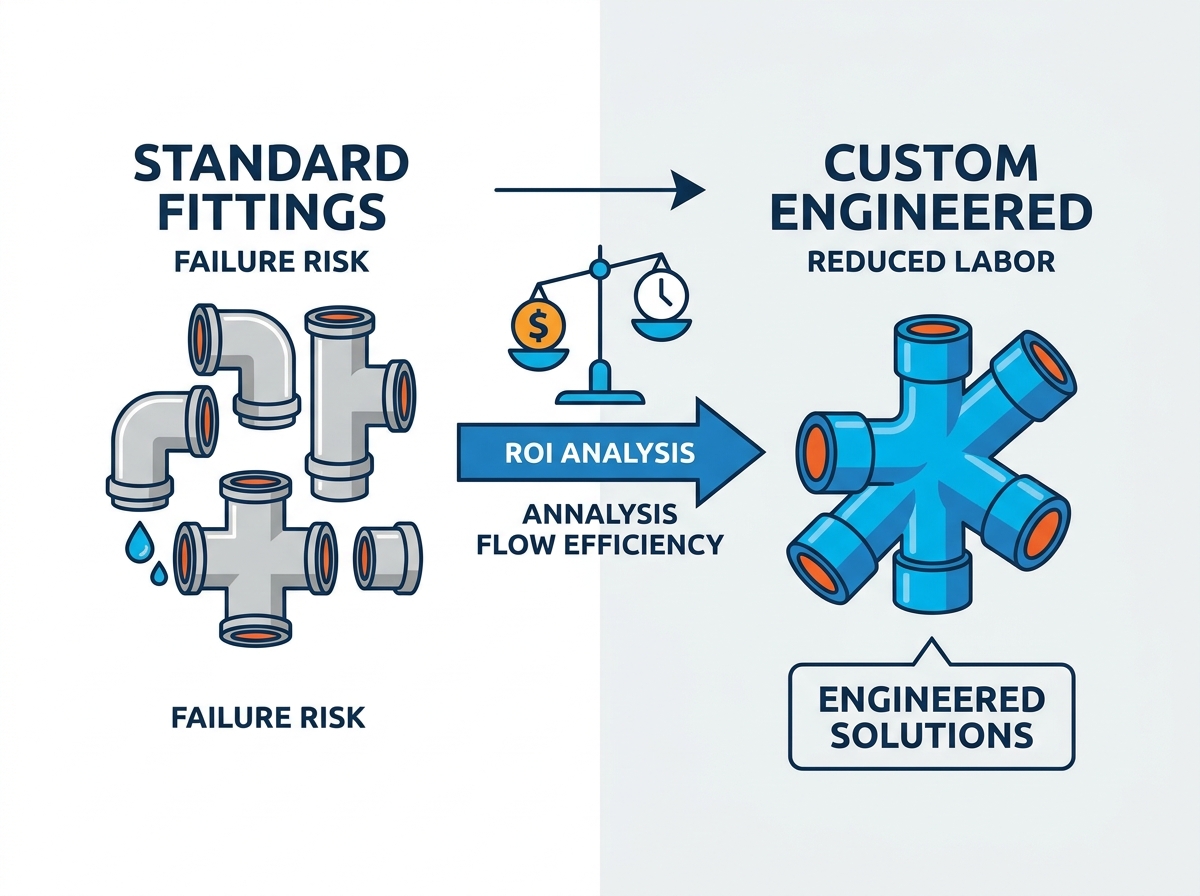
However, these standard components introduce severe failure risks when forced into complex, non-standard configurations. Installers often resort to excessive solvent welding to navigate tight spatial constraints. They might bend pipes beyond their natural radius to force alignments. Sometimes, they daisy-chain multiple adapters together to achieve a specific angle or diameter reduction. Every newly added joint multiplies the statistical probability of a leak. Redundant connections weaken the overall structural integrity of the fluid management system.
You must define strict success criteria before transitioning to a CPVC plumbing fitting customization strategy. Engineered solutions must deliver measurable operational improvements to justify their upfront costs. When evaluating a custom approach, we look for three primary achievements:
Elimination of redundant joint connections: A single custom mold replaces complex, multi-piece adapter assemblies.
Improvement of flow characteristics: Engineered internal geometries reduce turbulence and maintain optimal fluid pressure retention.
Reduction of manual labor hours: Installers complete faster assemblies by cementing one unified part instead of assembling puzzle-like configurations.
Critical Scenarios for Customization in Commercial Environments
Certain high-stakes environments rapidly expose the limitations of mass-produced plumbing parts. Engineers must recognize when standard geometries compromise systemic safety or efficiency. In these specific applications, customized solutions transition from optional upgrades to absolute operational necessities. We routinely see three primary scenarios where custom engineering solves critical field challenges.
High-Rise Commercial Buildings: Vertical construction introduces extreme hydrostatic pressure challenges. You must manage complex water distribution networks efficiently. Integrating custom commercial buildings CPVC plumbing fitting solutions optimizes pressure-reducing valve (PRV) stations. Custom manifolds fit perfectly into non-standard mechanical shaft dimensions. They eliminate bulky workarounds in cramped utility closets.
Industrial and Chemical Handling: Industrial plants routinely route aggressive fluids and highly corrosive chemicals. Standard joint intersections create severe vulnerability to chemical attack. They also suffer accelerated degradation from continuous thermal expansion cycles. Custom molded fittings eliminate vulnerable seams in critical transport lines. You ensure thicker walls precisely where turbulence or chemical exposure peaks.
Prefabricated Construction: Modern construction heavily favors modular, pre-assembled plumbing pods. These factory-built units require highly specialized, multi-port components. Standard parts rarely align perfectly with fixed wall assemblies. Custom multi-port fittings snap securely into place along engineered framing brackets. They allow off-site manufacturers to scale production quickly and consistently.
Evaluating CPVC Plumbing Fitting Specifications for Custom Runs
Engineering a unique part requires deep respect for inherent polymer limitations. You cannot design a fitting merely based on spatial convenience. It must withstand aggressive operational stresses over decades of continuous service. Acknowledging the absolute boundaries of CPVC ensures your custom design performs safely. The material typically handles a maximum operating temperature of 200°F (93°C). Custom designs must never compromise minimum wall thickness to achieve complex internal angles. Thin sections invite catastrophic bursts under surge pressures.
Dimensional tolerances play a critical role during the mold design phase. Engineers must align custom molds strictly with mandatory SDR (Standard Dimension Ratio) requirements. The customized sockets must seamlessly accept standard Schedule 40 or Schedule 80 pipes. Even minor dimensional deviations prevent proper solvent cement curing. If the socket is too loose, the joint will inevitably leak. If it is too tight, installers cannot properly seat the pipe before the cement sets.
Compliance and certification remain the highest hurdles for custom designs. Your engineered part must maintain strict adherence to ASPE guidelines and regional building codes. The design must satisfy ASTM D2846 parameters for hot and cold water distribution. Industrial applications require alignment with ASTM F437 through F439. Furthermore, any part touching potable water must carry NSF/ANSI 14 and 61 mandates. Meeting these CPVC plumbing fitting specifications requires rigorous third-party laboratory verification.
Specification / Standard | Application Focus | Key Compliance Requirement |
|---|---|---|
ASTM D2846 | Residential / Light Commercial | Hot and cold water distribution system limits. |
ASTM F437 - F439 | Industrial / High-Pressure | Schedule 80 threaded and socket-type requirements. |
NSF/ANSI 14 & 61 | Potable Water Safety | Zero toxic leaching into drinking water supplies. |
SDR Alignment | Dimensional Integrity | Strict wall thickness to pipe diameter ratios. |
Cost vs. ROI: Is a Custom Mold Worth the Investment?
Custom manufacturing demands significant initial capital. Buyers must carefully evaluate the upfront financial requirements before committing. The process begins with extensive CAD engineering and mechanical design fees. Engineers then produce prototype 3D prints to verify spatial fitment before cutting metal. The most substantial expense involves machining the actual steel mold tooling. High-quality steel molds withstand millions of injection cycles but require heavy initial investment. Finally, you must account for comprehensive burst and thermal laboratory testing fees.
Minimum Order Quantity (MOQ) realities often dictate project feasibility. Manufacturers cannot afford to pause high-volume production lines for a handful of custom parts. Therefore, custom runs only make sense for high-volume commercial projects. They also suit continuous OEM manufacturing pipelines perfectly. If you only need fifty pieces for a single mechanical room, a custom mold remains financially impractical. You need production runs in the thousands to amortize the expensive steel mold costs effectively.
Buyers must calculate a precise break-even point to justify the transition. You must offset the high initial cost of a custom CPVC plumbing fitting through measurable field savings. Engineered parts provide zero-leak reliability, eliminating costly rework. They facilitate exponentially faster on-site assembly. Installers complete tasks in minutes rather than hours. Furthermore, eliminating multi-joint adapters drastically reduces long-term warranty claims. When you calculate these combined operational savings across a massive commercial build, the return on investment often materializes well before project completion.
Vetting a CPVC Plumbing Fitting Supplier for Custom Orders
Not all plastics manufacturers possess the engineering infrastructure required for specialized projects. You must aggressively vet potential partners before awarding a tooling contract. Begin by assessing their internal engineering capabilities. A highly qualified CPVC plumbing fitting supplier offers robust in-house CAD and CAM design services. They should conduct finite element analysis (FEA) to simulate stress concentrations. FEA testing identifies weak points in the digital model before anyone cuts expensive steel. This preventative step saves months of costly trial and error.
Resin sourcing separates premium manufacturers from unreliable vendors. Custom geometries often endure unique stress loads, requiring top-tier material strength. You must verify your supplier uses virgin, certified CPVC compounds. Some facilities cut corners by mixing degraded regrind material into their production hoppers. Regrind severely compromises thermal resilience and impact strength. Always demand certificates of material origin to guarantee structural integrity.
Robust Quality Assurance (QA) protocols ensure every production batch meets your stringent specifications. Ask potential vendors to outline their internal testing procedures transparently. You should demand comprehensive documentation of destructive testing. They must perform regular burst pressure testing on random production samples. Thermal cycling resilience checks ensure the part survives rapid temperature fluctuations. Finally, strict dimensional quality control checks guarantee the ten-thousandth part fits precisely as well as the first prototype.
Evaluation Metric | Qualified Supplier | Subpar Supplier |
|---|---|---|
Design Validation | In-house CAD/CAM & FEA stress simulations. | Relies on buyer to provide flawless ready-to-cut files. |
Material Sourcing | 100% Virgin, certified CPVC compounds. | Uses unknown percentages of degraded regrind. |
Quality Assurance | Documented burst, thermal, and SDR checks. | Only performs basic visual surface inspections. |
Implementation Risks and Transition Roadblocks
Introducing non-standard components into a massive construction project carries inherent logistical risks. Project managers must anticipate these hurdles to avoid costly delays. Lead time hazards represent the most common operational disruption. Designing, prototyping, and cutting custom steel tooling can add 8 to 12 weeks to your timeline. You cannot afford to halt construction while waiting for the factory. Smart managers develop careful strategies for phasing standard and custom components. They order standard pipes early and schedule the custom nodes for later installation phases.
Code approval friction poses a severe regulatory threat. Local municipal inspectors routinely reject unfamiliar or non-standard fittings. If they do not see a recognized standard stamp, they will fail the inspection. You must preemptively secure variances before installation begins. Provide your inspectors with engineer-stamped specifications and independent laboratory test results. Clear, transparent communication with regulatory bodies prevents costly tear-outs and project shutdowns.
Finally, installer adoption dictates the ultimate success of your custom integration. Plumbers develop muscle memory using familiar, off-the-shelf parts. Introducing unusual custom geometries can easily lead to field errors. Installers might apply incorrect solvent cement techniques or misalign the insertion angles. You must mitigate these field errors through proactive education. Provide highly clear handling instructions alongside the new parts. Outline the exact solvent welding procedures required for your specific custom joints. Proper field training guarantees your engineered design achieves its intended performance.
Best Practice: Always request first-article inspection reports before authorizing mass production.
Best Practice: Conduct a joint training session with your lead plumbing foremen before materials arrive on site.
Common Mistake: Failing to submit custom specification sheets to local inspectors during the initial permitting phase.
Conclusion
Transitioning to custom CPVC fittings remains a rigorous engineering and financial calculation, not a casual upgrade. It requires proven volumetric demand and strict operational necessity. You must weigh the heavy upfront tooling costs against the massive long-term benefits of reduced labor and zero-leak reliability. Standard parts simply cannot navigate complex industrial routing or high-rise space constraints safely.
Buyers should actively isolate their most frequent points of failure or their highest-labor installation nodes. You can then determine if a single custom fitting will effectively solve that specific bottleneck. Do not customize every part; target the configurations causing the most friction. As a next-step action, identify your most problematic plumbing junction today. Reach out to a qualified, compliance-certified manufacturer to request a design feasibility study and a prototype tooling quote.
FAQ
Q: What is the typical minimum order quantity (MOQ) for custom CPVC fittings?
A: MOQs vary significantly depending on the manufacturer and part complexity. Generally, production runs start in the thousands of units. High volumes are necessary to effectively amortize the expensive upfront costs of machining steel molds. Small batches rarely make financial sense unless intended for highly specialized, premium industrial equipment.
Q: Do custom CPVC fittings maintain the same pressure ratings as standard commercial buildings CPVC plumbing fitting?
A: Yes. Custom fittings can easily be engineered to match or exceed standard Schedule 40 or Schedule 80 pressure ratings. Engineers ensure the wall thickness, internal geometries, and virgin resin quality strictly meet or surpass established ASTM specifications.
Q: How long does the prototyping and tooling process take?
A: You should anticipate a realistic timeline of 6 to 12 weeks. The CAD design and 3D prototyping phase usually takes 2 to 4 weeks. Creating the actual steel mold and passing the rigorous first-article inspections requires an additional 4 to 8 weeks.
Q: Can a custom fitting void my existing plumbing system warranty?
A: System warranties heavily depend on uniform material usage and approved solvent cements. Introducing a non-certified custom fitting carries significant liability and may void broad system warranties. This underscores the absolute need for stringent supplier testing and proper code certifications prior to installation.